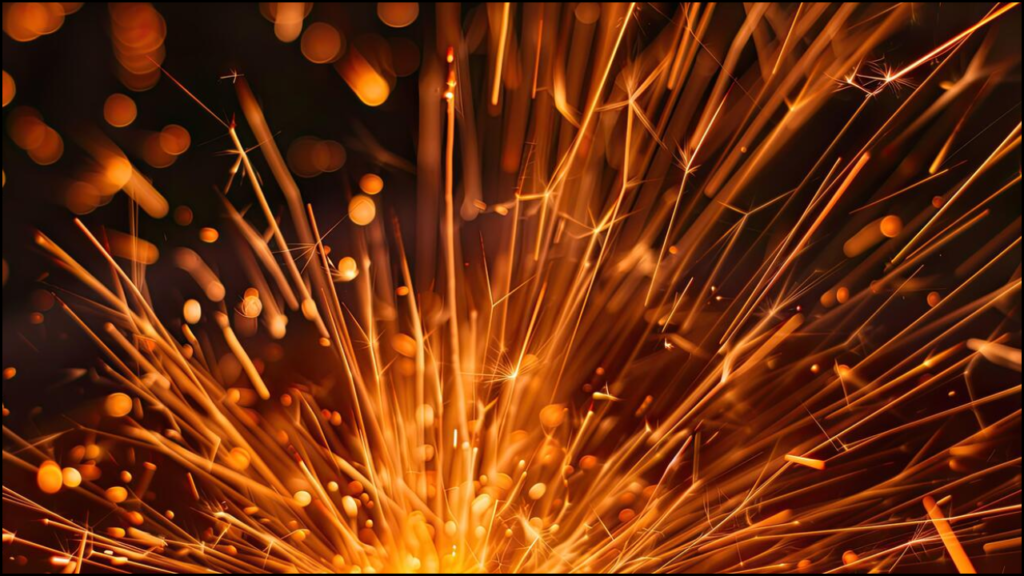
Sparks rising from a fire are a common observation, yet the science behind it is often misunderstood. Their upward movement is a result of heat, air density differences, and combustion dynamics working together. Understanding these principles not only satisfies curiosity but also informs safety practices, especially in fire-prone areas. By examining the physics of sparks, students and enthusiasts can visualize how fire interacts with its environment.
Table of Contents
Overview: Sparks Science
| Aspect | Details |
|---|---|
| Main Cause | Hot air rising due to lower density |
| Contributing Factor | Combustion of particles generates heat and sparks |
| Air Role | Convection currents push sparks upward |
| Safety Concern | Sparks can ignite nearby flammable materials |
| Learning Benefit | Explains basic physics concepts to students |
Heat Effect
Heat is the primary reason sparks rise. When a fire burns, it heats the surrounding air, making it less dense than the cooler air around it. This difference in density causes the hot air to rise, carrying sparks along with it. The rising motion is a visual demonstration of convection, a principle seen in many natural and man-made systems, from boiling water to weather patterns.
Understanding the heat effect helps explain why small, lightweight sparks travel higher and faster than larger or cooler ones. By observing spark movement, learners can see real-world physics in action. Simple experiments with controlled sparks allow students to visualize convection and comprehend how temperature differences drive air movement.
Combustion Role
Combustion generates sparks when burning materials shed small, hot particles. These particles, being light and hot, are easily carried upward by rising air. Factors such as fuel type, temperature, and oxygen supply influence the size, color, and trajectory of sparks. For instance, dry wood produces smaller, quicker-rising sparks compared to denser materials like coal.
Studying combustion’s role in spark movement highlights the interaction between chemical reactions and physical processes. Experiments can demonstrate how variations in combustion conditions affect spark behavior. This knowledge is crucial for safe campfires, industrial processes, and understanding wildfire risks.
Air Currents
Air currents play a significant role in determining spark paths. Even gentle breezes can alter the trajectory, pushing sparks sideways or accelerating their upward movement. Convection currents created by heated air drive the natural ascent of sparks, while environmental factors such as wind or ventilation affect how sparks disperse in an area.
Recognizing the influence of air currents helps in designing fire-safe spaces and controlling indoor combustion. Educators can use spark demonstrations to show students how air pressure, wind, and ventilation interact with fire. This practical understanding enhances both safety and appreciation of physics principles.
Safety Implications
Sparks rising may appear harmless, but they can ignite nearby flammable materials. Understanding why sparks rise informs safety strategies, such as clearing combustible debris, maintaining safe distances, and using protective barriers. Awareness of spark behavior is particularly vital in wildfire-prone areas and during controlled burns.
Educational programs often demonstrate the dangers of sparks in a controlled setting, teaching learners preventive measures. Recognizing how sparks travel helps homeowners, campers, and firefighters reduce the risk of accidental fires. Applying physics knowledge to safety creates both awareness and preparedness.
Educational Value
Learning why sparks fly upward introduces students to basic physics concepts like convection, heat transfer, and combustion dynamics. Hands-on experiments and visual demonstrations make these ideas tangible. By connecting observation to scientific explanation, educators can engage students and foster curiosity about natural phenomena.
Interactive lessons allow students to see the direct effect of heat, air movement, and combustion on spark motion. This knowledge can also inspire further exploration in fields such as thermodynamics, environmental science, and fire safety engineering. Understanding Sparks combines scientific insight with practical, real-world applications.
Key Takeaways
The upward movement of sparks is a clear example of physics in action. Heat causes air to rise, combustion produces hot particles, and air currents direct spark paths. By studying these phenomena, learners gain a better grasp of scientific principles while learning essential safety precautions. Understanding sparks provides insight into fire behavior and equips people to handle fire responsibly.