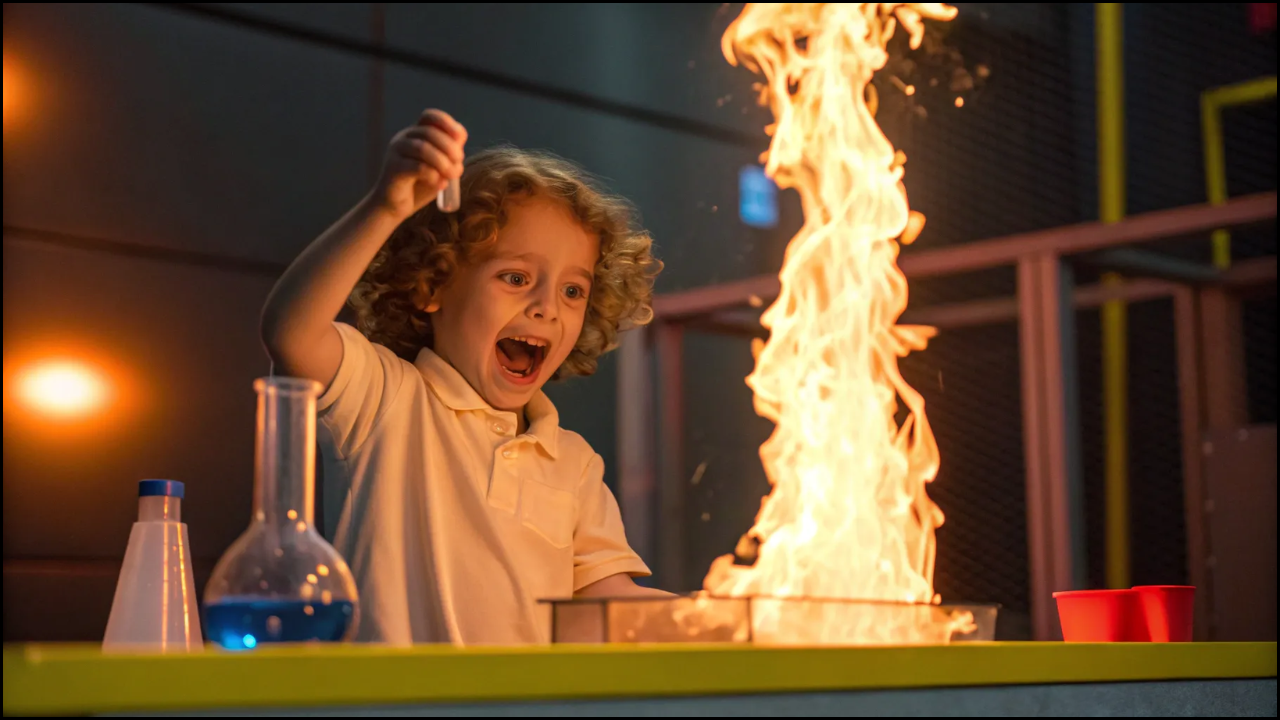
Fire and sparks offer some of the clearest real-life examples of basic physics principles. From the way flames rise to how sparks drift upward, these everyday observations help explain ideas that might otherwise feel abstract. Heat, air movement, and forces become visible when fire is involved, making learning more intuitive and engaging.
Using fire and sparks as teaching tools allows students to connect theory with what they see around them. These simple observations turn complex physics concepts into easy, memorable lessons that apply both inside and outside the classroom.
Table of Contents
Overview Of Physics Lessons
| Physics Concept | Explanation |
|---|---|
| Heat Energy | Fire releases thermal energy |
| Air Movement | Warm air rises above flames |
| Density Change | Hot air becomes lighter |
| Force Balance | Upward lift competes with gravity |
| Visible Learning | Sparks show physics in action |
Heat Energy
Heat is a form of energy that changes how matter behaves. When something burns, stored chemical energy turns into heat and light. This heat immediately affects nearby air, surfaces, and particles.
Fire demonstrates how energy moves and spreads. Students can observe that heat does not remain still but travels outward, influencing everything around it. Sparks glowing above flames are proof that energy transfer is taking place.
Temperature Change
Temperature measures how fast particles move. Fire dramatically increases temperature, causing air molecules to move faster and spread apart.
As the temperature rises, the air begins to behave differently. This visible change helps students understand that temperature is not just a number but a factor that directly affects motion and behavior in the physical world.
Air Density
Air density refers to how closely packed air molecules are. Cool air has tightly packed molecules, making it heavier. Heated air spreads out and becomes lighter.
Fire shows this difference clearly. The lighter, heated air rises above the flame, carrying smoke and sparks upward. This natural process explains why sparks rarely fall straight down.
Convection Motion
- Hot air rises above the fire
- Cool air moves in to replace it
- Continuous circulation forms
- Sparks follow rising air paths
- Heat drives the entire process
Convection is the movement of heat through fluids like air. Fire creates strong convection currents that lift sparks upward, making invisible air motion easy to observe.
Buoyant Force
Buoyancy is an upward force exerted by fluids on objects within them. Even though air is invisible, it can push objects upward when heated.
Sparks experience buoyant force when surrounded by hot air. This force helps overcome gravity for a short time, allowing sparks to rise before cooling down.
Gravity Effect
Gravity constantly pulls objects toward the ground. Sparks are no exception, but gravity is not always the strongest force acting on them.
When sparks are hot and light, upward air movement can overpower gravity. As sparks cool and lose heat, gravity becomes dominant again, causing them to fall or fade away.
Flame Direction
- Flames point upward naturally
- Rising air shapes flame movement
- Calm air produces straight flames
- Wind alters flame direction
- The flame shape shows airflow
Flame direction provides clues about air movement. The upward stretch of flames shows that hot air is moving vertically, reinforcing lessons about convection and pressure differences.
Smoke Behavior
Smoke behaves much like sparks, making it a safe visual substitute in learning environments. It rises with hot air and slows as it cools.
Observing smoke helps students understand that air movement is responsible for lifting particles. The same physics applies whether the particles are smoke, steam, or sparks.
Pressure Changes
Heating air reduces its pressure near the flame. This creates a low-pressure zone that draws cooler, higher-pressure air inward.
This pressure difference keeps air moving and feeds the fire with oxygen. Fire teaches students that pressure and temperature are closely connected and constantly influence each other.
Everyday Examples
Fire-based physics lessons connect easily to daily life. Chimneys work because hot air rises. Hot air balloons float using the same principle. Even weather patterns rely on temperature and pressure differences.
Recognizing these connections helps students see physics as practical rather than theoretical. Fire becomes a familiar example that explains much larger systems.
Safety Learning
Understanding physics through fire also builds safety awareness. Knowing that sparks rise and travel helps explain why fires spread upward and outward.
This knowledge encourages responsible behavior around heat sources. Learning physics through fire is most effective when paired with respect and caution.
Classroom Value
Fire and sparks provide strong visual learning opportunities. Even without open flames, teachers can use demonstrations involving warm air and lightweight materials to explain the same principles.
These lessons improve engagement and retention. Students are more likely to remember concepts they can see and relate to real experiences.
Concept Integration
Fire brings multiple physics concepts together in one place. Heat transfer, air density, pressure, and force balance all interact at the same time.
This integration helps students understand how physics principles work together rather than in isolation. Fire becomes a complete learning system rather than a single example.
Practical Thinking
Studying fire-based physics builds analytical skills. Students learn to ask why sparks rise, what forces are involved, and how conditions change outcomes.
This type of thinking supports deeper understanding and prepares learners for more advanced scientific topics in the future.
Closing Perspectives
Fire and sparks make physics simple by turning invisible forces into visible motion. Heat energy changes air density, creates pressure differences, and drives convection that lifts sparks upward. By observing these effects, students gain a clear understanding of core physics concepts. Using fire as a learning tool transforms complex ideas into practical, easy-to-understand lessons that stay with learners long after the flame goes out.