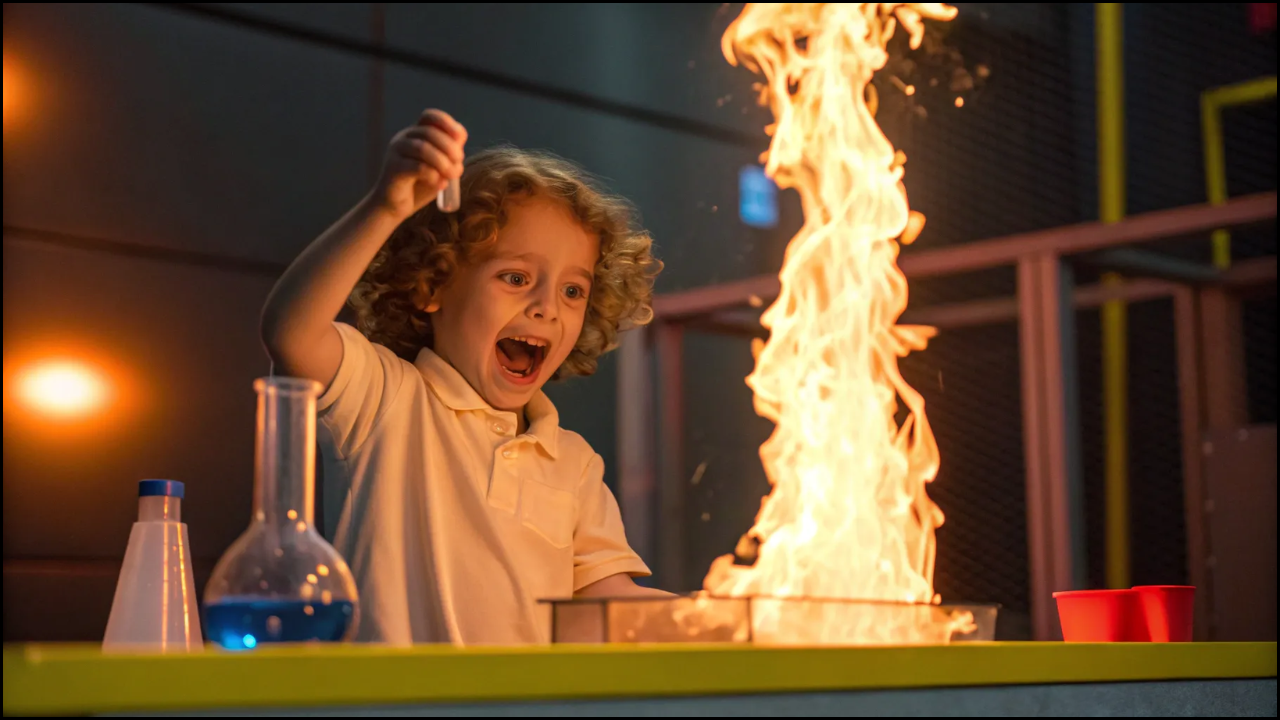
Children are naturally curious about fire, smoke, and moving air. Watching sparks rise upward from a flame often leads to simple yet important questions about heat and motion. This topic provides an excellent opportunity to teach kids basic science concepts using safe, visual, and easy-to-understand explanations.
By using a simple experiment and clear reasoning, children can learn how heat affects air and why sparks move upward instead of falling down. Teaching this concept builds early scientific thinking while reinforcing safety awareness around heat and fire.
Table of Contents
Overview Of The Learning Experiment
| Element | Explanation |
|---|---|
| Main Concept | Heat makes air rise |
| Key Observation | Sparks move upward with hot air |
| Science Focus | Air density and convection |
| Learning Level | Suitable for children |
| Safety Goal | Fire awareness and caution |
Learning Purpose
The purpose of this experiment is to help kids visually understand how heat changes air movement. Instead of abstract explanations, children learn by watching motion happen in front of them. Seeing sparks rise makes the idea of hot air rising easier to remember.
This lesson also connects science to real-life situations. From campfires to candles, children start recognizing heat behavior everywhere, turning everyday observations into learning moments.
Heat Basics
Heat is a form of energy that makes things warmer. When something heats up, its particles move faster. This happens not only in solids and liquids but also in gases like air.
When air becomes warm, it spreads out and becomes lighter. Lighter air naturally moves upward, which explains why warm air does not stay close to the ground.
Air Movement
Air moves in response to temperature differences. Warm air rises, while cool air sinks to take its place. This creates a cycle of movement called convection.
In the experiment, children can observe this cycle clearly. The rising air above a flame carries small particles, showing how air movement works even when it cannot be seen directly.
Simple Experiment
- Light a candle with adult supervision
- Observe the flame and rising smoke
- Blow out the candle carefully
- Watch the smoke move upward
- Discuss why the smoke rises
This simple setup demonstrates heat-driven air movement without danger. Smoke replaces sparks in this experiment, making it safe for children while still showing the same scientific principle.
Spark Comparison
Although sparks are not used directly, the smoke behaves similarly. Sparks rise for the same reason smoke does: hot air lifts them upward.
Explaining this comparison helps children connect the experiment to real fires they may have seen in pictures or outdoor settings. It bridges safe learning with real-world understanding.
Why Sparks Rise
Sparks are tiny pieces of hot material. Because they are hot and light, they are easily carried by rising air.
As the air above a flame heats up, it moves upward and takes sparks along with it. Gravity pulls sparks down, but the upward push from hot air is stronger at first.
Cooling Effect
- Sparks cool as they rise
- Hot air gradually loses heat
- Upward force becomes weaker
- Gravity starts to pull sparks down
- Sparks fade and disappear
This explains why sparks do not rise forever. Cooling changes air movement, helping kids thoroughly understand the balance between forces.
Daily Examples
Children can relate this lesson to everyday experiences. Warm air rising explains why balloons float when filled with hot air and why steam rises from hot food.
Linking the experiment to daily life strengthens understanding. Kids begin noticing heat behavior around them naturally.
Safety Awareness
Teaching heat science also teaches safety. Children learn that sparks and flames are not toys and should be observed only with adult supervision.
Understanding why sparks rise helps children respect fire rather than fear it. Knowledge builds responsible behavior around heat sources.
Teaching Tips
- Use clear and simple language
- Encourage kids to describe what they see
- Ask why questions after observation
- Repeat the experiment if needed
- Reinforce safety rules consistently
Interactive discussion improves learning outcomes. Letting children explain the motion in their own words strengthens comprehension.
Learning Benefits
This experiment supports early science education by introducing key concepts without complexity. Kids learn about heat, air, and movement memorably.
It also builds observation skills and curiosity. Simple experiments like this form the foundation for more advanced scientific learning later.
Wrapping Up
Understanding why sparks fly upward helps children grasp how heat affects air movement. Through a simple, safe experiment, kids can see convection in action and learn that warm air rises while cool air sinks. By combining observation, explanation, and safety awareness, this lesson makes heat science engaging, practical, and easy to understand for young learners.