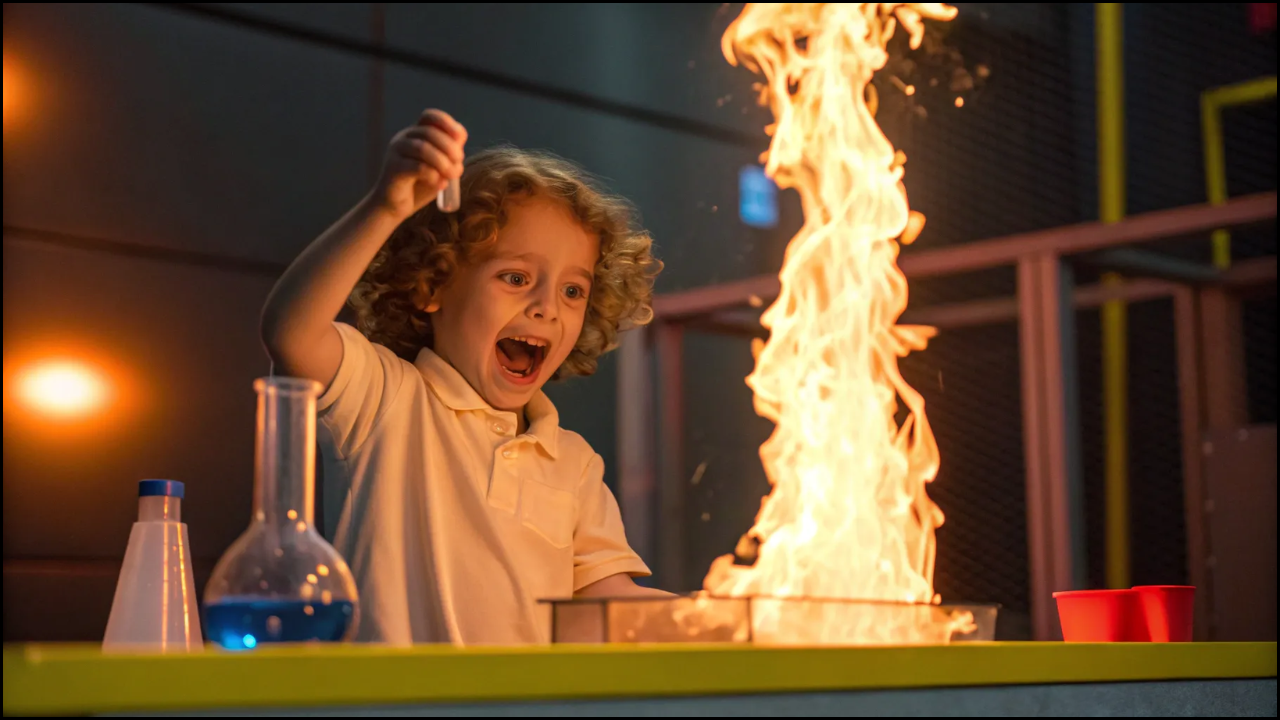
Rising sparks capture attention instantly, making them a powerful teaching tool in STEM education. What appears to be a simple visual effect actually demonstrates core scientific principles involving physics, chemistry, and environmental science. Observing how sparks behave allows students to connect theory with real-world phenomena.
By studying rising sparks, learners gain insight into heat transfer, air movement, and force balance. This topic supports STEM learning by encouraging observation, experimentation, and scientific reasoning through an everyday yet fascinating process.
Table of Contents
Overview Of Rising Sparks In STEM
| STEM Area | Explanation |
|---|---|
| Physics | Explains forces and motion |
| Chemistry | Describes combustion reactions |
| Engineering | Applies heat and airflow control |
| Technology | Uses sensors and safety systems |
| Education Value | Connects theory to observation |
Combustion Science
Combustion is a chemical reaction where fuel reacts with oxygen to release heat, light, and gases. This reaction provides the energy that starts spark formation. Small particles break away from burning material and glow due to retained heat.
In STEM learning, combustion introduces students to chemical energy conversion. Sparks act as visible evidence of chemical reactions happening at a microscopic level, making abstract chemistry concepts easier to understand.
Heat Transfer
Heat transfer occurs when energy moves from a hotter area to a cooler one. Fire transfers heat to the surrounding air, rapidly increasing its temperature. This transfer is essential for spark movement.
Students learn that heat does not stay still. Instead, it spreads through conduction, radiation, and convection. Rising sparks are a direct outcome of convective heat transfer.
Air Density
Air density decreases as temperature increases. When air heats up, its molecules move faster and spread apart, making the air lighter than the surrounding cooler air.
This density difference is a foundational physics concept. STEM learners can observe density effects in real time as sparks rise, reinforcing lessons about matter and temperature.
Convection Currents
- Hot air rises above the heat source
- Cooler air moves inward to replace it
- Continuous air circulation forms
- Sparks follow airflow paths upward
- Stronger heat creates faster movement
Convection currents are responsible for lifting sparks. These currents act like invisible pathways, allowing students to visualize air movement that is otherwise unseen.
Force Balance
Sparks are influenced by multiple forces at once. Gravity pulls them downward, while the buoyant force from rising hot air pushes them upward.
STEM education emphasizes understanding how forces interact. Rising sparks show how upward forces can temporarily overcome gravity, providing a clear example of force balance in action.
Engineering Applications
Engineering fields apply spark behavior knowledge to improve safety and efficiency. Ventilation systems, spark arresters, and fire-resistant designs rely on understanding how sparks move.
By studying rising sparks, students see how science turns into practical solutions. Engineering connects theory to real-world problem-solving.
Technology Role
- Heat sensors detect abnormal temperature rise
- Airflow systems control spark movement
- Fire suppression limits spark spread
- Monitoring devices track combustion
- Automation improves safety response
Technology integrates scientific understanding into systems that manage fire risks. Rising spark behavior informs the design of these technologies.
Environmental Science
Rising sparks play a role in wildfire spread. Sparks lifted by hot air can ignite dry vegetation far from the original fire source.
Environmental science uses this knowledge to study fire behavior, land management, and ecosystem protection. Students learn how small physical processes can lead to large environmental impacts.
Experimental Learning
Hands-on experiments strengthen STEM learning. Safe classroom demonstrations using smoke or lightweight materials allow students to observe convection without danger.
These experiments encourage inquiry-based learning. Students form hypotheses, observe outcomes, and draw conclusions based on evidence.
Critical Thinking
Studying rising sparks develops analytical skills. Students must identify variables such as heat intensity, air movement, and particle size.
This process supports scientific thinking by promoting cause-and-effect reasoning. Learners move beyond memorization toward deeper understanding.
Cross-Disciplinary Value
Rising sparks connect multiple STEM disciplines in a single concept. Physics explains motion, chemistry explains reactions, engineering applies solutions, and environmental science explores impact.
This integration highlights the interconnected nature of STEM fields. Students see that real-world phenomena rarely belong to just one subject.
Future Implications
Understanding spark behavior prepares students for advanced STEM studies. Fire science, aerospace engineering, environmental research, and safety engineering all rely on these principles.
Early exposure to such concepts builds confidence and curiosity. Rising sparks become a gateway to deeper scientific exploration.