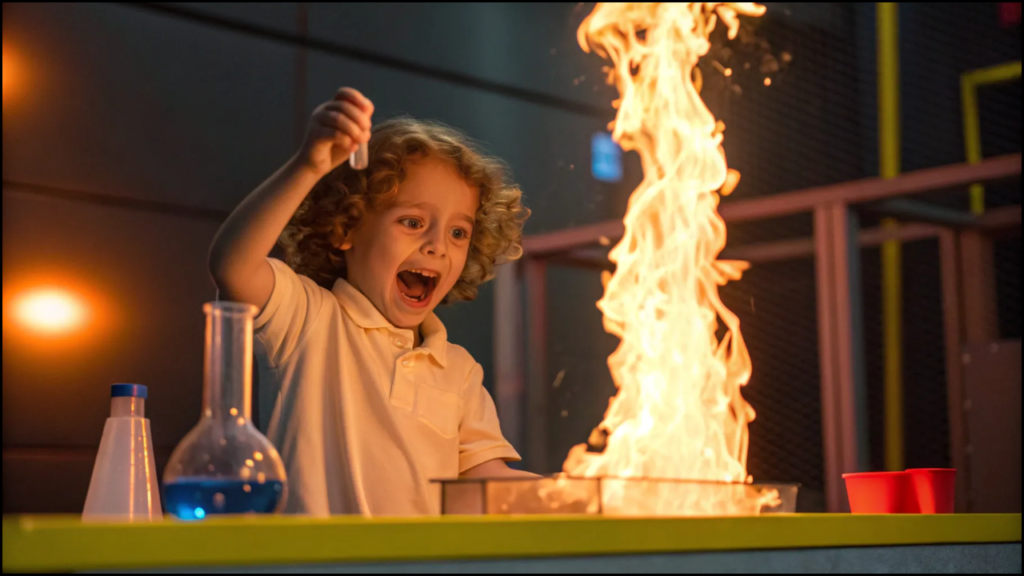
Fire is more than just burning fuel; it is a dynamic system driven by heat and air movement. One of the most important processes controlling how flames behave and how sparks travel is convection. This natural movement of air explains why fire spreads upward and why sparks rarely move downward.
For students and general readers, convection offers a simple yet powerful way to understand fire behavior. By exploring how heated air rises and creates motion, the upward journey of sparks becomes easy to visualize and scientifically clear.
Table of Contents
Overview Of Convection Effects
| Aspect | Explanation |
|---|---|
| Heat Source | Fire heats surrounding air rapidly |
| Air Movement | Hot air rises, cool air sinks |
| Convection Flow | Continuous vertical air circulation |
| Spark Transport | Rising air carries sparks upward |
| Fire Shape | Flames stretch upward due to airflow |
Convection Meaning
Convection is the transfer of heat through the movement of fluids such as air or water. Instead of heat traveling through direct contact, warm fluid moves from one place to another, carrying energy with it.
In a fire, air acts as the fluid. Once heated, it starts moving upward, taking heat, smoke, and sparks along. This movement forms the backbone of fire behavior and explains many visible flame patterns.
Heat Source
Fire releases a large amount of heat in a small area. This heat immediately warms the air around the flame, causing it to expand. Expanded air becomes lighter than the surrounding cooler air.
Because lighter air cannot remain below heavier air, it starts rising. This upward motion begins almost instantly after combustion starts, setting convection in motion.
Air Density
Air density changes with temperature. Cold air is dense because its molecules are packed closely together. Hot air has faster-moving molecules that spread apart, making it less dense.
This density difference is the driving force behind convection. When fire heats air, the lighter air moves upward, while heavier cool air moves in to replace it, maintaining constant circulation.
Convection Currents
- Hot air rises directly above the flame
- Cooler air flows inward at lower levels
- A vertical loop of air movement forms
- Heat remains concentrated above the fire
- Sparks follow the rising air pathway
These convection currents act like invisible elevators. Once sparks enter these upward-moving air streams, they are lifted quickly away from the fire source.
Spark Formation
Sparks are tiny glowing pieces of burning material such as ash, wood, or metal. They form when small fragments break away from the main fuel during combustion.
Because sparks are small and lightweight, they respond easily to moving air. Convection currents provide enough lift to carry them upward even though gravity is constantly pulling them down.
Buoyant Force
Buoyancy is the upward force exerted by a fluid on an object. In the case of fire, hot air provides buoyant force to sparks suspended within it.
The hotter the air, the stronger the buoyant force. Intense fires create powerful convection currents, allowing sparks to rise higher and travel farther before cooling.
Gravity Balance
Gravity always acts on sparks, pulling them toward the ground. However, convection-generated upward forces often exceed gravitational pull during active burning.
As sparks lose heat and become heavier relative to the surrounding air, the buoyant force weakens. At that point, gravity dominates, and sparks begin to fall or drift sideways.
Fire Shape
- Flames stretch upward due to rising air
- Fire rarely spreads downward naturally
- Vertical flame shape shows convection strength
- Stronger fires create taller flames
- Airflow controls flame direction
The familiar upward shape of flames is direct evidence of convection. Fire grows in the direction that hot air moves, reinforcing the upward motion of sparks.
Environmental Impact
The surrounding environment influences convection behavior. Enclosed spaces trap hot air, strengthening upward airflow and sparking movement. Open areas allow heat to disperse, reducing convection strength.
Wind can tilt convection currents, causing sparks to travel sideways. Still, the basic upward tendency remains because hot air always seeks higher levels.
Fire Safety
Understanding convection helps explain fire hazards. Rising sparks can ignite materials located above or downwind from a fire source.
Fire safety planning accounts for convection-driven movement. Ventilation design, clearance above flames, and spark barriers are all based on controlling convection effects.
Final Thoughts
Convection plays a central role in fire and spark movement by driving hot air upward through density differences and buoyant forces. This rising air shapes flames, lifts sparks, and controls how fire behaves in different environments. By understanding convection, students gain a clearer and safer understanding of why fire and sparks move the way they do.