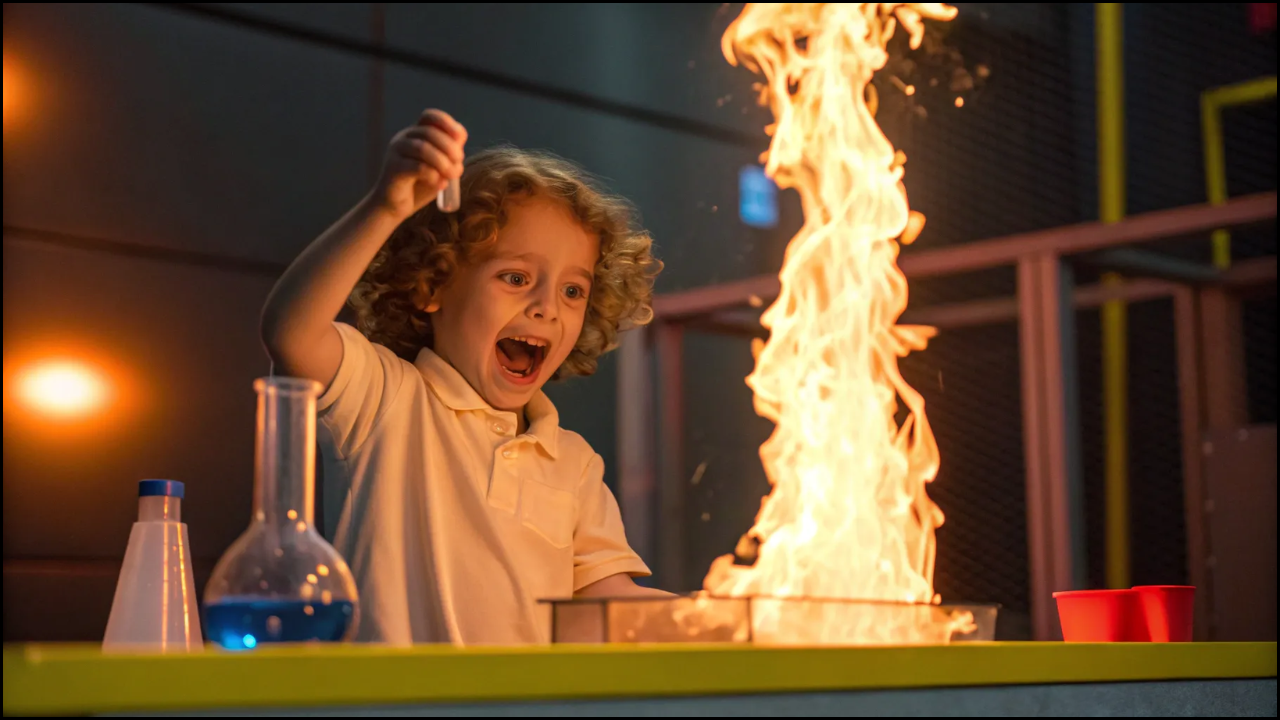
Watching sparks rise from a campfire or candle often sparks curiosity, especially for students learning basic science. This upward motion may look magical, but it follows simple and clear physics rules. Heat, air movement, and forces acting on particles work together to guide sparks skyward.
Understanding this concept helps students connect classroom physics to real-world observations. By breaking the process into easy ideas, the science behind rising sparks becomes logical, memorable, and practical.
Table of Contents
Overview Of Spark Motion
| Concept | Explanation |
|---|---|
| Heat Production | Fire releases strong heat energy |
| Air Expansion | Heated air spreads and becomes lighter |
| Density Change | Hot air is less dense than cool air |
| Upward Force | Light air naturally moves upward |
| Spark Transport | Rising air carries sparks with it |
Basic Physics
Physics explains how forces and energy affect objects around us. When something burns, energy stored in fuel is released as heat and light. This heat immediately affects the air surrounding the fire.
Air is a fluid, just like water, and it reacts strongly to temperature changes. Once heated, air begins to move, and this movement is the foundation of why sparks rise instead of falling straight down.
Heat Effects
Heat causes air molecules to move faster and spread farther apart. As the air expands, it becomes lighter compared to the cooler air around it. This difference in weight is critical for motion.
Lighter air cannot stay below heavier air for long. Nature always pushes lighter substances upward, which is why hot air balloons rise, and sparks follow the same basic rule.
Air Density
Density describes how tightly packed molecules are in a substance. Cool air has tightly packed molecules, making it heavier. Hot air has loosely packed molecules, making it lighter.
When a fire heats the air, the density drops quickly. The surrounding cooler air then pushes underneath the hot air, forcing it upward and creating a rising air stream that lifts sparks.
Buoyancy Force
Buoyancy is an upward force that acts on objects in fluids like air. Even though sparks are solid particles, they are small and light enough to be affected by this force.
As sparks enter rising hot air, buoyancy helps overcome gravity. The stronger the heat, the stronger the buoyant force, allowing sparks to rise higher before cooling down.
Convection Currents
- Hot air rises straight up from the fire
- Cool air moves in to replace rising air
- A circular air movement forms naturally
- Sparks get caught in rising air paths
- Continuous heat keeps the motion active
These convection currents act like invisible highways for sparks. Once sparks enter these moving air streams, they travel upward smoothly until the air cools.
Spark Weight
Sparks are tiny pieces of burning material, such as ash or metal. Their small size means gravity has a weaker pull on them compared to heavier objects.
Because sparks are so light, even gentle upward airflow can lift them. Larger sparks rise less, while smaller sparks can travel surprisingly high before fading away.
Gravity Balance
Gravity always pulls objects toward the ground, including sparks. However, gravity is not the only force acting during combustion.
When upward forces from hot air are stronger than gravity, sparks rise. As sparks cool and lose heat, the upward force weakens, and gravity slowly pulls them back down.
Daily Examples
- Smoke rising from incense sticks
- Steam lifting from boiling water
- Hot air balloons floating upward
- Chimney smoke moving vertically
- Heat waves are visible above flames
These everyday examples show the same physics principles at work. Sparks behave just like smoke and steam because they are carried by rising hot air.
Safety Learning
Understanding spark movement is important for safety awareness. Rising sparks can land on dry leaves, clothing, or nearby materials and start fires.
Students learning this physics concept also learn why fire safety rules matter. Keeping distance from flames and controlling airflow helps reduce spark-related risks.
Simple Experiment
A safe classroom demonstration can help students visualize the idea. Lighting a candle and observing smoke movement after blowing it out shows how warm air rises.
Teachers often use paper spirals above warm objects to show convection. These simple activities reinforce how heat creates motion without complex equipment.
Key Takeaways
Sparks fly upward because heat makes air lighter, and lighter air always rises. This rising air creates upward forces that carry tiny sparks along. Gravity still acts, but it is overpowered by heat-driven air movement during burning. By understanding air density, buoyancy, and convection, students can clearly see how simple physics explains this everyday phenomenon.