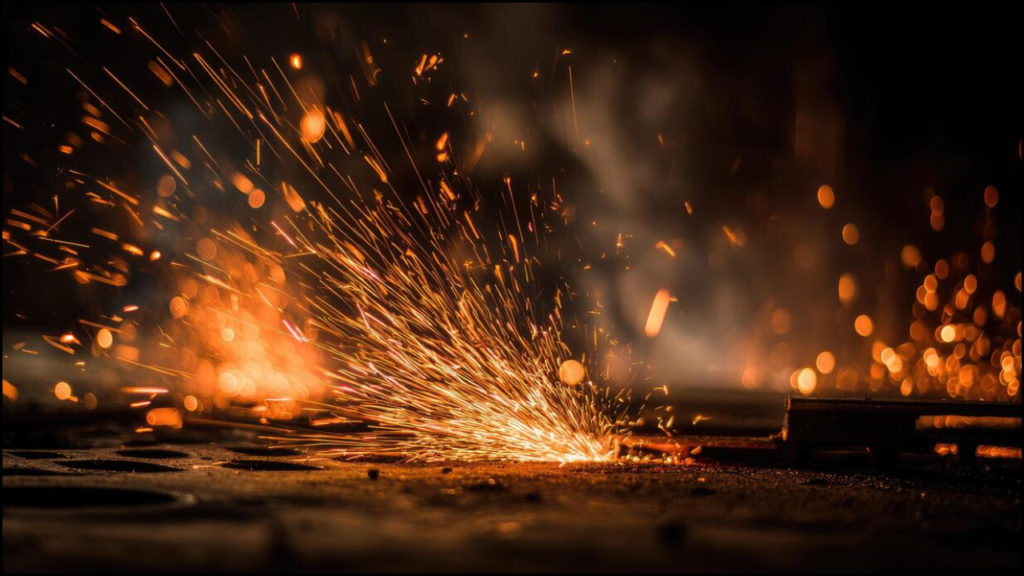
Welding and metal cutting produce striking visual effects, including sparks that seem to defy gravity by shooting upward. While sparks may appear random, their upward motion is governed by clear scientific principles involving heat, air movement, and particle properties. Understanding these factors is important for safety, engineering, and learning about physical processes.
Rising sparks during metalwork are not just dramatic—they are a result of high temperatures, lightweight particles, and convection currents. Recognizing why sparks behave this way helps both professionals and hobbyists manage risks and apply physics concepts in real-world settings.
Table of Contents
Overview Of Metal Sparks
| Factor | Explanation |
|---|---|
| Heat Source | Welding arcs and grinding create extreme temperatures |
| Metal Particles | Tiny fragments become incandescent |
| Convection | Hot air rises, lifting sparks |
| Particle Size | Small, lightweight sparks are easily carried |
| Safety Consideration | Sparks can ignite flammable materials nearby |
Heat Generation
Welding and cutting involve high-energy processes. Electrical arcs or friction from grinding rapidly heat the metal surface, causing small fragments to break off. These fragments are instantly heated to glowing temperatures and become visible as sparks.
The heat released in these processes is sufficient to raise the temperature of the surrounding air. This interaction between hot particles and heated air is key to understanding why sparks rise.
Air Movement and Convection
When air heats up, it becomes less dense and rises. This upward movement creates convection currents around the welding or cutting area. Sparks, being small and lightweight, are easily carried by these rising air streams.
The stronger the heat, the more vigorous the convection. As a result, sparks travel upward faster and farther than they would if only gravity were acting on them.
Particle Size and Weight
The size and mass of metal particles directly affect their motion. Small sparks are light enough to be lifted easily by rising air, whereas larger fragments may fall quickly due to gravity.
This is why welding and grinding often produce a shower of tiny sparks moving upward, while heavier debris stays closer to the surface.
Oxidation Heat
As sparks move through the air, they continue to react with oxygen. This oxidation releases additional heat, keeping the particles glowing and buoyant for a short time.
The extra heat prolongs their upward motion, allowing sparks to rise higher before cooling and falling. This phenomenon also explains why sparks appear brighter in the initial moments after formation.
Gravity Interaction
Gravity always acts on sparks, pulling them downward. However, in welding and cutting, the upward lift from hot air and buoyancy often exceeds the downward force of gravity temporarily.
Once sparks cool or the convection weakens, gravity dominates, causing them to drop or extinguish safely.
Workshop Airflow
- Open spaces or ventilation fans can alter spark paths
- Enclosed areas may slow down motion
- Air turbulence can spread sparks sideways
- Smooth vertical airflow allows maximum spark lift
- Understanding airflow is critical for spark control
Proper ventilation and awareness of airflow patterns improve safety and help manage spark behavior during welding and cutting operations.
Safety Implications
Sparks can ignite flammable objects, dust, or chemicals nearby. Knowing that sparks rise helps professionals identify high-risk zones above and around the work area.
Using fire-resistant shields, maintaining clear workspaces, and wearing protective equipment reduces the chance of accidents and injuries.
Practical Applications
Understanding why sparks rise informs equipment design, such as spark guards, hoods, and extraction systems. Engineers and safety planners apply this knowledge to limit spark spread and protect workers and property.
Recognizing the physics behind sparks also aids in teaching and explaining combustion, heat transfer, and air movement in practical settings.
The Bottom Line
The upward motion of sparks during welding and metal cutting illustrates the interaction of heat, air movement, and particle dynamics. By understanding these processes, professionals can improve safety, manage fire risks, and use sparks as a clear demonstration of basic physics principles in industrial and educational contexts.