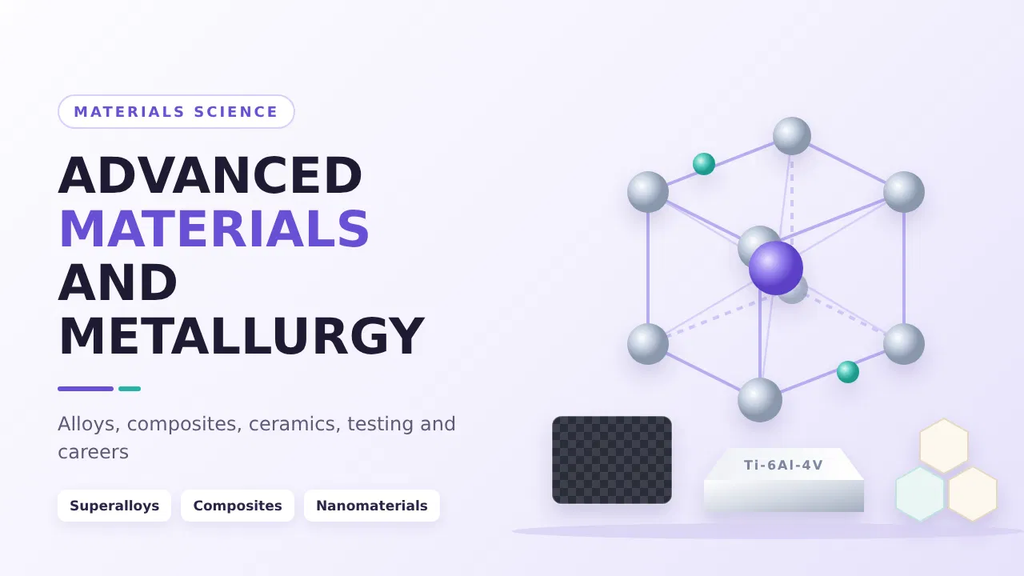
Advanced materials and metallurgy sit at the heart of almost every modern technology. Lighter aircraft, safer cars, longer-lasting bridges, efficient power plants, electric vehicle batteries and medical implants all depend on materials engineered for specific strength, weight, heat resistance and durability.
Metallurgy, the science of metals and alloys, has been practised for thousands of years, but today it works hand in hand with materials science, chemistry, physics and computer modelling. Engineers can now design alloys atom by atom, create composites stronger than steel at a fraction of the weight and print complex metal parts directly from digital files. This guide explains the key types of advanced materials, metallurgical processes, testing methods, industrial uses and career opportunities in this fast-growing field.
Table of Contents
What Is Metallurgy
Metallurgy is the study of the physical and chemical behaviour of metals and their alloys. It covers how metals are extracted from ores, how they are refined and combined into alloys, and how their internal structure affects properties such as strength, hardness, ductility and corrosion resistance.
The field is usually divided into three main areas. Extractive metallurgy deals with getting metals from ores. Physical metallurgy studies the structure and properties of metals. Process or mechanical metallurgy focuses on shaping metals through casting, forging, rolling, welding and heat treatment.
What Are Advanced Materials
Advanced materials are engineered materials with superior performance compared to conventional ones. They are designed for demanding environments such as extreme heat, high stress, corrosive chemicals or the need for very low weight.
These materials include high-performance alloys, ceramics, composites, polymers, nanomaterials and smart materials. Many of them combine properties that were once thought impossible together, such as high strength with light weight, or hardness with toughness.
Major Categories of Advanced Materials
High-Strength and Specialty Steels
Advanced high-strength steels, dual-phase steels and martensitic steels allow carmakers to build lighter bodies that still protect passengers in a crash. Tool steels, maraging steels and stainless grades serve industries from aerospace to food processing.
Superalloys
Nickel-based and cobalt-based superalloys keep their strength at temperatures above 1,000 degrees Celsius. They are used in jet engine turbine blades, gas turbines, rocket engines and nuclear reactors, where ordinary metals would soften or fail.
Titanium and Light Alloys
Titanium alloys offer high strength, low weight and excellent corrosion resistance, making them ideal for aircraft frames, medical implants and chemical equipment. Aluminium-lithium and magnesium alloys further reduce weight in aircraft, cars and electronics.
Composites
Composites combine two or more materials to achieve better performance. Carbon fibre reinforced polymers are extremely strong and light, and are used in aircraft wings, racing cars, wind turbine blades and sports equipment. Metal matrix and ceramic matrix composites handle high temperatures in engines and brakes.
Advanced Ceramics
Technical ceramics such as silicon carbide, silicon nitride, alumina and zirconia are very hard, heat resistant and electrically insulating. They are found in cutting tools, engine components, body armour, electronic substrates and dental implants.
Nanomaterials and Smart Materials
Nanomaterials like graphene and carbon nanotubes show remarkable strength and conductivity. Smart materials respond to their environment: shape memory alloys return to a set shape when heated, piezoelectric materials generate electricity under pressure, and self-healing polymers can repair small cracks on their own.
| Material | Key Property | Main Use |
|---|---|---|
| Superalloys | Extreme heat strength | Jet Engines, Turbines |
| Titanium Alloys | Light, corrosion proof | Aircraft, Implants |
| Carbon Fibre | Very high stiffness | Aerospace, Sports |
| Technical Ceramics | Hard, heat resistant | Tools, Armour |
| Graphene | Strength, conductivity | Electronics, Batteries |
| Shape Memory Alloy | Returns to shape | Stents, Actuators |
Key Metallurgical Processes
The properties of a metal depend not only on its chemistry but also on how it is processed.
- Alloying: adding elements like chromium, nickel, molybdenum or vanadium to improve strength and corrosion resistance
- Heat treatment: annealing, hardening, quenching and tempering to control hardness and toughness
- Surface engineering: carburising, nitriding, coatings and plating to improve wear resistance
- Powder metallurgy: pressing and sintering metal powders to make precise parts with little waste
- Additive manufacturing: 3D printing metal parts layer by layer from powder or wire
- Thermo-mechanical processing: combining rolling and controlled cooling to refine grain structure
Materials Testing and Characterisation
Engineers must prove that materials meet design requirements before they are used in critical parts. Tensile tests measure strength and elongation, hardness tests check surface resistance, and impact tests show toughness at low temperatures. Fatigue and creep tests reveal how materials behave under repeated loads and long-term heat.
Microscopy is used to study internal structure. Optical microscopes, scanning electron microscopes and X-ray diffraction reveal grain size, phases and defects. Non-destructive testing methods such as ultrasonic, radiographic and eddy current inspection detect hidden flaws in finished components without damaging them.
Industries Driving Demand
Aerospace and defence require lightweight, heat-resistant and ultra-reliable materials. The automotive and electric vehicle industry needs high-strength steels, aluminium alloys and advanced battery materials such as lithium, nickel, cobalt and new solid-state electrolytes. Energy sectors depend on corrosion-resistant alloys for oil and gas, superalloys for turbines and special materials for solar panels, wind turbines and hydrogen systems.
Healthcare uses titanium, cobalt-chrome and bioceramics for implants and surgical tools. Electronics rely on semiconductors, rare earth elements and thin-film materials. Construction benefits from weathering steels, high-performance concrete and fibre-reinforced polymers that extend the life of bridges and buildings.
Computational Materials Science
Modern materials development increasingly happens on computers before it reaches the lab. Simulation tools predict how atoms will arrange, how alloys will behave under stress and how heat treatment will change properties. Artificial intelligence and machine learning now screen thousands of possible alloy combinations quickly, cutting development time from decades to a few years. Integrated computational materials engineering links these models directly with product design.
Sustainability and Critical Materials
Producing metals consumes large amounts of energy, so the industry is working to cut emissions through recycling, green steel, hydrogen-based reduction and renewable power. Aluminium and steel are highly recyclable without losing quality. At the same time, critical minerals such as lithium, cobalt and rare earths are becoming strategic resources, leading countries to invest in mining, refining and battery recycling. These trends create strong opportunities for investors, mining companies and materials startups.
Failure Analysis and Material Selection
When a component breaks, metallurgists investigate the cause through failure analysis. They study fracture surfaces, microstructure and service conditions to find whether the failure came from fatigue, corrosion, overload, poor heat treatment or manufacturing defects. These findings help companies prevent repeat failures, improve designs and settle warranty or insurance claims fairly.
Choosing the right material at the design stage avoids many of these problems. Engineers balance strength, weight, cost, corrosion resistance, ease of manufacturing and availability. Material selection charts and databases help compare options quickly, while life-cycle cost analysis shows whether a more expensive alloy will save money through longer service life and lower maintenance.
Careers in Materials and Metallurgy
Graduates in metallurgical and materials engineering work as process metallurgists, quality engineers, welding engineers, failure analysts, research scientists and product development engineers. Employers include steel plants such as Tata Steel, JSW and SAIL, aerospace organisations like HAL and ISRO, defence laboratories, automotive companies, oil and gas firms and research institutes. Advanced degrees and research experience open roles in battery technology, semiconductors and additive manufacturing, which offer some of the highest salaries in engineering.
Conclusion
Advanced materials and metallurgy make modern technology possible, from lighter cars and efficient engines to medical implants and clean energy systems. By combining traditional metallurgical knowledge with composites, ceramics, nanomaterials, smart materials and computer modelling, engineers continue to push the limits of performance. For businesses, investors and students, this field offers lasting opportunities as the world demands stronger, lighter and more sustainable materials.