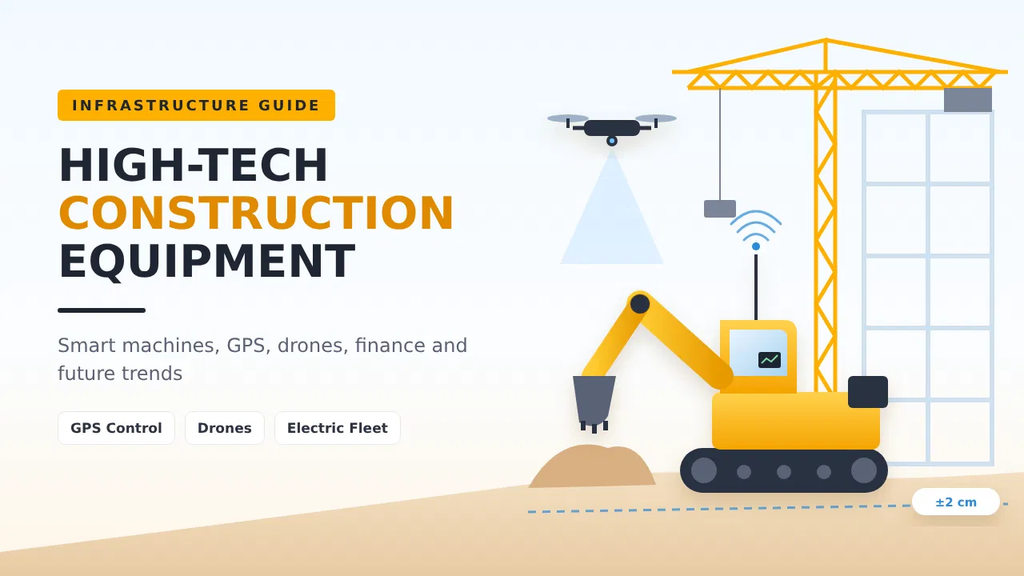
High-tech construction equipment is changing how roads, bridges, buildings and infrastructure projects are built. Modern machines now come with GPS guidance, telematics, automation and electric drives, allowing contractors to work faster, use less fuel and achieve higher accuracy than ever before.
Construction has traditionally relied on operator skill and manual measurement. Today, smart excavators, autonomous rollers, drones and 3D printers can complete tasks with centimetre-level precision while reducing rework and safety risks. For contractors, builders and equipment owners, understanding these technologies is essential to stay competitive, control costs and win larger projects. This guide covers the key high-tech machines, their benefits, costs, financing and the trends shaping the future of construction.
Table of Contents
What Makes Construction Equipment High-Tech
High-tech construction equipment combines traditional heavy machinery with digital technology. Sensors, GPS receivers, onboard computers, cameras and wireless connectivity turn excavators, dozers, cranes and loaders into smart machines that can measure, guide and even operate themselves.
These systems give operators real-time information about depth, slope, load and position. Fleet managers can track every machine from an office or mobile app, monitor fuel use and schedule maintenance before breakdowns happen.
Key Types of High-Tech Construction Equipment
Several categories of advanced equipment are now common on large construction sites.
Smart Excavators
Modern excavators from brands like Caterpillar, Komatsu, Volvo, Hitachi and JCB offer 2D and 3D grade control. The machine knows the exact position of the bucket and compares it with the digital design, guiding the operator or controlling the boom automatically. This reduces over-digging and the need for survey stakes.
GPS-Guided Dozers and Graders
Dozers and motor graders with machine control systems from companies such as Trimble, Topcon and Leica Geosystems automatically adjust blade height and angle to match design surfaces. Road and site levelling work becomes faster and more accurate, with fewer passes and less material waste.
Intelligent Compaction Rollers
Smart rollers measure soil and asphalt stiffness as they compact and map the results in real time. Operators can see which areas need more passes, ensuring uniform quality across the entire road or foundation.
Advanced Cranes
Tower cranes and mobile cranes now feature load moment indicators, anti-collision systems, remote monitoring and camera views of the hook. These features prevent overloads and accidents on busy high-rise sites.
Electric and Hybrid Machines
Battery-electric excavators, loaders and compact equipment produce zero exhaust emissions and much lower noise. They are ideal for urban projects, tunnels and indoor demolition. Hybrid machines recover energy during swinging and braking to cut fuel consumption.
Construction Drones
Drones capture aerial images and survey data in minutes. Software converts these images into 3D models and accurate volume measurements for stockpiles and earthwork. Drones also help monitor progress and inspect hard-to-reach structures safely.
3D Concrete Printers
Large-scale 3D printers build walls and structures layer by layer using special concrete mixes. They reduce labour, speed up construction and allow creative shapes. Several countries, including India, have already completed 3D-printed houses and buildings.
Robotic and Autonomous Machines
Bricklaying robots, rebar-tying machines, autonomous compactors and remote-controlled demolition robots handle repetitive or dangerous tasks. Autonomous haul trucks are already common in large mining operations and are slowly entering construction.
| Equipment | Key Technology | Main Benefit |
|---|---|---|
| Smart Excavator | 3D grade control | Accurate digging |
| GPS Dozer | Automatic blade | Faster levelling |
| Smart Roller | Compaction mapping | Uniform quality |
| Electric Loader | Battery drive | Zero emissions |
| Survey Drone | Aerial mapping | Fast measurement |
| 3D Printer | Layered concrete | Less labour |
Telematics and Fleet Management
Telematics systems collect data from machines and send it to cloud platforms. Contractors can see machine location, working hours, idle time, fuel use and fault codes in one dashboard. This helps reduce fuel theft, improve utilisation and plan maintenance based on actual usage.
Geofencing alerts owners if a machine leaves the site or operates outside permitted hours, adding protection against theft. Data from telematics also supports more accurate project costing and bidding for future work.
BIM and Digital Construction Workflow
Building Information Modelling, known as BIM, creates a detailed digital model of a project before construction starts. When this model is linked with machine control systems, equipment can follow the design directly. Engineers can detect clashes between structure, plumbing and electrical systems early, avoiding costly changes on site. Digital twins of completed projects also help owners manage maintenance throughout the building’s life.
Benefits for Contractors and Builders
- Higher productivity with fewer passes and less rework
- Lower fuel consumption and operating costs
- Improved accuracy that meets tight design tolerances
- Better safety through cameras, sensors and collision warnings
- Reduced dependence on surveyors and manual checks
- Real-time data for better project control and billing
- Stronger chance of winning large government and private contracts
Cost, Financing and Rental Options
High-tech machines cost more than conventional equipment, and machine control kits, drones and software subscriptions add to the investment. However, savings in fuel, labour, material and time often recover the extra cost within a few projects.
Contractors commonly finance equipment through construction equipment loans from banks such as SBI, HDFC Bank, ICICI Bank and Axis Bank, as well as NBFCs like Tata Capital, Shriram Finance and SREI-type lenders specialising in infrastructure equipment. Leasing and rental are popular for short projects or specialised machines, letting companies use the latest technology without large upfront payments. Many manufacturers also offer buyback and upgrade programmes.
Construction equipment insurance and contractor’s plant and machinery policies protect against accidents, theft, fire and breakdown. For high-value machines, comprehensive cover is strongly recommended, and good telematics data can help reduce premiums.
How to Choose the Right Equipment
Buying or renting high-tech machines should start with a clear look at the type of projects you handle. Road builders benefit most from GPS graders, intelligent rollers and paver automation, while building contractors gain more from smart cranes, compact electric machines and drones for progress tracking.
- Match machine size and technology level to your regular project scope
- Check dealer support, spare parts availability and service response time
- Confirm compatibility between machine control systems and your design software
- Compare fuel efficiency, resale value and warranty terms across brands
- Ask for operator training as part of the purchase or rental package
Challenges in Adopting New Technology
Higher upfront prices, the need for operator training, reliable GPS signals and internet connectivity on remote sites are common challenges. Smaller contractors may find it difficult to justify costly systems for small jobs. Starting with one or two machines, renting advanced equipment for specific projects and training a core team of operators can make the transition smoother.
Career Opportunities
The shift to smart equipment is creating demand for machine control technicians, drone pilots, BIM coordinators, telematics analysts and skilled operators trained on GPS-guided machines. Operators with experience on modern excavators and cranes are highly sought after in India, the Gulf countries and Australia, where large infrastructure projects are under way.
Future of Construction Equipment
The industry is moving toward fully autonomous machines, electric fleets, hydrogen-powered heavy equipment and AI-driven site planning. Machines will increasingly communicate with each other and with project software, coordinating tasks automatically. Sustainability rules and rising fuel costs will further speed up the adoption of electric and hybrid equipment worldwide.
Conclusion
High-tech construction equipment brings precision, efficiency and safety to modern building and infrastructure projects. Smart excavators, GPS dozers, intelligent rollers, drones, electric machines and 3D printers are reshaping how work gets done on site. By choosing the right technology, using smart financing and rental options, protecting assets with proper insurance and investing in operator training, contractors can lower costs, deliver better quality and stay ahead in a fast-changing industry.