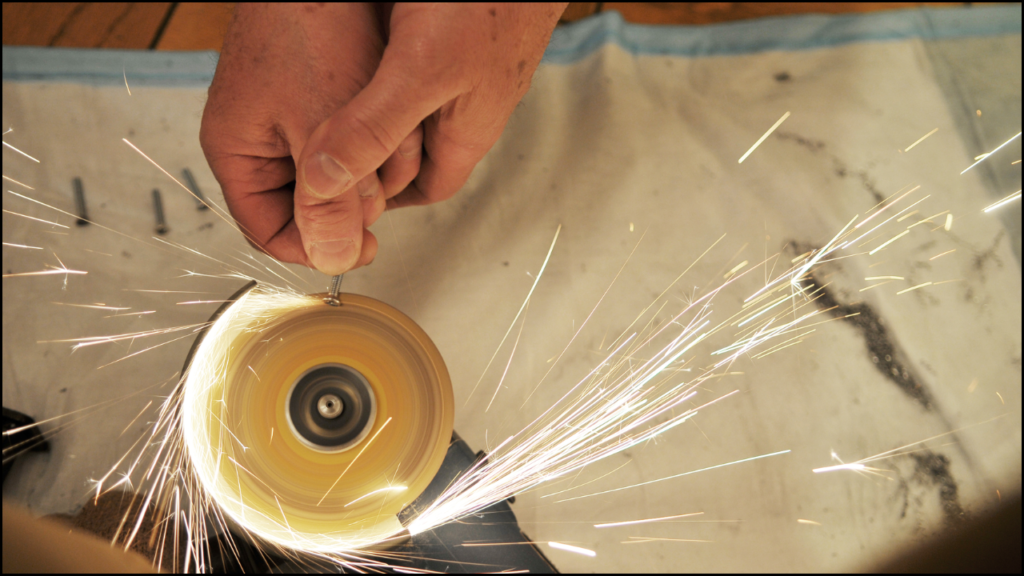
Welding and metal grinding often produce bright, fast-moving sparks that seem to shoot upward against gravity. While this may look surprising at first, the movement of these sparks follows clear physical principles related to heat, air movement, and particle behavior. In industrial and workshop settings, understanding this phenomenon is important for both learning and safety.
Rising sparks are not random. They are the result of intense heat generation, rapid air expansion, and lightweight metal particles interacting with their surroundings. Exploring why sparks fly upward during welding or grinding helps explain common workshop observations and highlights potential fire risks.
Table of Contents
Overview Of Rising Metal Sparks
| Factor | Explanation |
|---|---|
| Heat Generation | Welding and grinding produce extreme heat |
| Metal Particles | Tiny hot fragments break away |
| Air Expansion | Heated air becomes lighter and rises |
| Buoyant Lift | Hot air carries sparks upward |
| Safety Impact | Sparks can ignite nearby materials |
Metal Spark Formation
During welding or grinding, metal surfaces are exposed to intense friction or electrical heat. This energy causes tiny pieces of metal to break off from the surface. These fragments become extremely hot due to rapid energy transfer.
As the metal particles oxidize in air, they glow brightly and appear as sparks. Their small size and high temperature allow them to stay hot long enough to interact strongly with the surrounding air.
Extreme Heat
Welding arcs and grinding contact points reach very high temperatures in a short time. This heat does not remain confined to the metal alone. It quickly spreads to the air around the working area.
The heated air expands rapidly and becomes lighter than the surrounding cooler air. This temperature difference is the foundation for upward spark movement in metalworking processes.
Air Density Change
Air density decreases when the temperature increases. Hot air produced during welding or grinding contains fast-moving molecules that spread farther apart. As a result, the air becomes less dense.
This lighter air naturally rises, creating airflow near the work surface. Sparks formed within this airflow are lifted upward rather than falling straight down.
Convection Flow
- Hot air rises above the welding zone
- Cooler air moves in from the surrounding areas
- Continuous air circulation forms
- Sparks enter rising air streams
- Strong heat intensifies upward motion
These convection currents act as invisible channels that guide sparks upward. The stronger the heat source, the faster and higher sparks are carried.
Particle Size
Metal sparks are extremely small and lightweight. Their low mass makes them highly sensitive to air movement. Even moderate upward airflow can easily overcome gravity for these particles.
Larger metal fragments fall quickly, while tiny sparks rise higher and travel farther. Particle size plays a major role in determining spark direction and distance.
Oxidation Energy
As metal sparks move through the air, they react with oxygen. This oxidation releases additional heat, keeping the particles hot for a short time.
This extra heat helps maintain low-density air around each spark. The surrounding hot air reinforces upward movement until the spark cools and loses energy.
Gravity Balance
Gravity constantly pulls metal sparks downward. However, during welding and grinding, upward forces often exceed gravitational pull.
As long as sparks remain hot and surrounded by rising air, they continue moving upward. Once they cool, gravity becomes dominant, causing sparks to fall or fade out.
Workshop Airflow
- Ventilation systems influence spark paths
- Fans can redirect rising sparks
- Enclosed spaces strengthen vertical movement
- Open areas allow wider dispersion
- Air currents affect spark landing zones
Workshop airflow significantly affects spark behavior. Controlled ventilation can reduce upward spark accumulation, while poor airflow can increase fire risk in elevated areas.
Fire Hazards
Rising metal sparks pose serious fire hazards in industrial settings. Sparks can land on overhead cables, insulation, dust layers, or stored materials.
Because sparks often reach hidden or elevated areas, fires may start unnoticed. Understanding spark movement helps identify high-risk zones that require extra protection.
Safety Measures
Effective safety practices focus on spark control. Spark shields, fire-resistant curtains, and proper workspace layout limit spark travel.
Regular cleaning removes flammable dust and residues. Wearing protective clothing also reduces the risk of injury from upward-moving sparks.
Equipment Design
Modern welding and grinding equipment often includes features designed to manage sparks. Guards, enclosures, and extraction systems reduce spark spread.
Engineering solutions apply knowledge of heat and airflow to improve safety. Understanding why sparks rise supports better equipment use and workplace planning.
Risk Awareness
Workers who understand spark behavior respond more effectively to hazards. Awareness reduces careless actions and improves compliance with safety protocols.
Training that explains the science behind rising sparks enhances both safety and confidence in industrial environments.
Final Analysis
Sparks fly upward during welding or grinding because intense heat warms the surrounding air, reducing its density and creating strong upward convection currents. Lightweight, glowing metal particles are easily carried by this rising air, temporarily overcoming gravity. Particle size, oxidation heat, and workshop airflow all influence spark movement. Understanding these principles is essential for improving safety, preventing fires, and managing risks in metalworking environments.