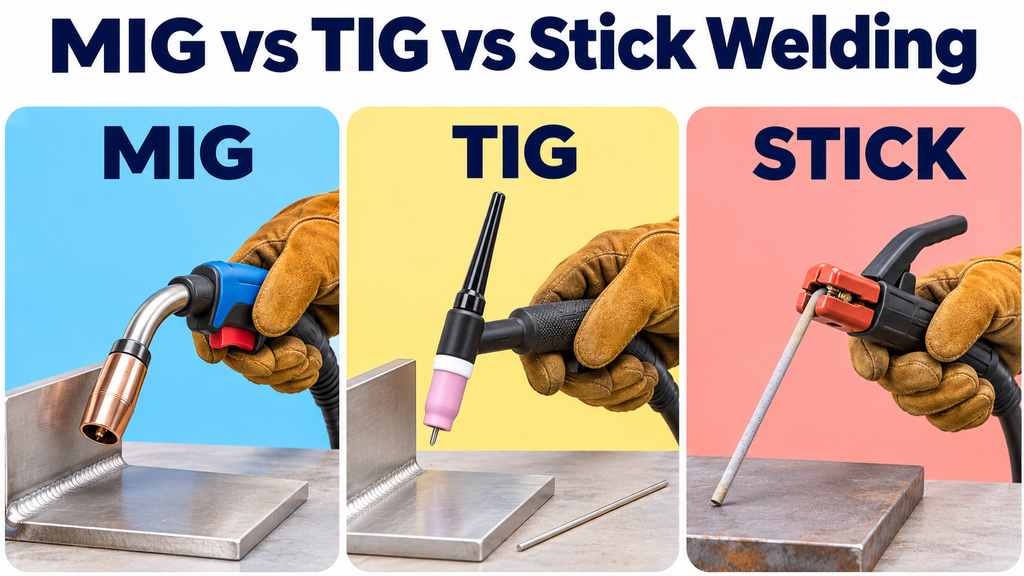
MIG, TIG and stick are the three most widely used arc welding processes, and each one has clear strengths. Choosing the right one depends on the metal, the job, your budget and how much time you can spend learning.
All three processes use an electric arc to melt and join metal, but they differ in how the arc is protected, how filler metal is added and how much skill they demand. MIG is known for speed and ease, TIG for precision and clean appearance, and stick for toughness in outdoor and repair work. This guide compares the three side by side, covering how each works, equipment costs, suitable metals, learning curves and career value, so you can decide which process fits your projects or trade goals.
Table of Contents
Quick Comparison of the Three Processes
| Process | Best Known For | Learning Curve |
|---|---|---|
| MIG (GMAW) | Speed and productivity | Easiest |
| TIG (GTAW) | Precision and clean welds | Hardest |
| Stick (SMAW) | Outdoor and heavy repair | Moderate |
MIG Welding Explained
MIG welding, formally called gas metal arc welding, feeds a continuous solid wire electrode through a gun. Pulling the trigger starts the wire feed, the arc and the flow of shielding gas at the same time. The wire melts into the joint as filler metal while the gas protects the molten pool from air.
For mild steel, the most common shielding gas is a mix of 75 percent argon and 25 percent carbon dioxide, which gives a stable arc and little spatter. Aluminium is welded with pure argon, usually with a spool gun to prevent the soft wire from tangling. A related process, flux-cored arc welding, uses a hollow wire filled with flux. Self-shielded flux-core needs no gas bottle, making it popular for outdoor work and beginner machines.
Advantages of MIG
- Fast welding with high deposition rates, ideal for production work.
- Easy to learn, with many beginners producing usable welds within days.
- Little cleanup, as solid-wire MIG produces no slag.
- Handles thin sheet metal through to medium-thick steel.
Limitations of MIG
- Wind blows away shielding gas, so gas MIG is poor outdoors.
- Needs clean metal for best results.
- Equipment is bulkier, with a wire feeder and gas cylinder.
- Poorly set machines can produce welds that look good but lack penetration.
TIG Welding Explained
TIG welding, or gas tungsten arc welding, uses a non-consumable tungsten electrode to create the arc. The welder holds the torch in one hand, feeds a separate filler rod with the other and often controls amperage with a foot pedal. Pure argon shields the weld.
TIG machines run on direct current for steel and stainless steel, while alternating current is used for aluminium and magnesium, because it breaks up the tough oxide layer on the surface. Because heat input is controlled so precisely, TIG produces clean, strong, spatter-free welds with a neat, stacked appearance.
Advantages of TIG
- The highest quality and most precise welds of the three processes.
- Works on the widest range of metals, including aluminium, stainless steel, copper, titanium and thin alloys.
- No spatter or slag, and little or no grinding afterwards.
- Excellent for thin materials and visible welds.
Limitations of TIG
- The slowest process, which raises labour costs on large jobs.
- Requires both hands and often a foot, demanding strong coordination.
- Metal must be very clean, usually brushed or degreased before welding.
- Machines with AC capability cost more.
Stick Welding Explained
Stick welding, or shielded metal arc welding, uses a consumable electrode rod coated in flux. As the rod melts, the flux creates a gas shield and a layer of slag that protects the cooling weld. No external gas is needed, and the equipment is simple: a power source, an electrode holder and a ground clamp.
Electrodes are chosen for the job. Common rods include 6010 and 6011 for deep penetration through dirty or rusty steel, 6013 for easy, smooth welds on light work, and 7018 low-hydrogen rods for strong structural welds that often need to pass inspection.
Advantages of Stick
- Works well outdoors and in windy conditions.
- Tolerates rust, paint and dirt better than MIG or TIG.
- Portable and inexpensive equipment, including engine-driven units for remote sites.
- Excellent for thick steel, structural work and repairs.
Limitations of Stick
- Slag must be chipped off after every pass.
- More spatter and a rougher finish.
- Frequent rod changes slow production.
- Difficult on thin sheet metal, which burns through easily.
Head-to-Head Comparison
Speed and Productivity
MIG is the clear winner for speed, especially in shops and factories where long, continuous welds are common. Stick is slower because of rod changes and slag removal, and TIG is the slowest, though its quality often justifies the time on critical joints.
Weld Quality and Appearance
TIG produces the cleanest, most precise welds and is preferred where appearance and purity matter. MIG gives neat welds with minimal cleanup. Stick welds are strong but rougher, though skilled welders can produce excellent structural results.
Metal Types and Thickness
TIG handles the broadest range of metals and the thinnest material. MIG suits steel, stainless steel and aluminium from thin sheet to moderate thickness. Stick is mainly used on carbon steel, cast iron and some stainless steel, and excels on thick sections.
Working Environment
Stick and self-shielded flux-core are best for outdoor, farm, pipeline and construction work. Gas MIG and TIG belong in shops or sheltered areas where shielding gas will not be disturbed.
Equipment and Running Costs
Costs vary widely by brand, power and features, but some general patterns hold.
| Process | Starter Machine Cost | Ongoing Costs |
|---|---|---|
| Stick | Lowest | Electrodes only |
| MIG | Moderate | Wire, gas, tips and liners |
| TIG | Highest, especially AC/DC | Argon, tungsten and filler rods |
Multi-process inverter machines that combine MIG, TIG and stick in one unit have become popular with small fabrication shops and serious hobbyists. They cost more than a single-process welder but less than buying three separate machines. Leading brands include Lincoln Electric, Miller, ESAB, Hobart and Everlast. For a business, financing equipment through a lease or small business loan can spread the cost while the machine earns income.
Which Process Should You Choose?
- Beginners and home garages: MIG or flux-core is the easiest starting point for general repairs, furniture and car projects.
- Farm, ranch and outdoor repairs: stick welding handles rusty equipment, thick steel and windy conditions.
- Automotive and motorsport: MIG for body panels and frames, TIG for roll cages, exhaust and aluminium parts.
- Stainless and food-grade work: TIG gives the clean, sanitary welds required.
- Structural steel and construction: stick and flux-core are common for beams and site work.
- Art and fine fabrication: TIG for precise, visible welds on thin or mixed metals.
Career and Earning Potential
Learning more than one process makes a welder far more employable. MIG skills are in demand in manufacturing and fabrication shops. Stick welding opens doors to construction, shipbuilding and structural work, while pipe welding using stick and TIG is among the best paid specialities, especially in oil, gas and power generation.
TIG specialists in aerospace, nuclear, pharmaceutical and food processing industries often command premium wages because of the precision required. Certifications such as American Welding Society structural tests or pipe qualifications to industry codes prove your skill to employers. Many community colleges and technical schools offer welding programmes, and financial aid or apprenticeship pay can help cover training costs.
Common Beginner Mistakes With Each Process
MIG Mistakes
New MIG welders often set the wire speed too high or the voltage too low, which creates a loud, spattery arc and cold, ropey beads sitting on top of the metal. Holding the gun too far from the work also lets air reach the weld and causes porosity. Follow the chart inside the machine door and keep a short, consistent stick-out.
TIG Mistakes
Touching the tungsten to the weld pool contaminates the electrode and the weld, forcing a stop to regrind it. Beginners also struggle with too much heat on thin metal and with feeding filler rod smoothly. Practising on clean scrap and keeping a sharp, properly ground tungsten makes a big difference.
Stick Mistakes
Rods sticking to the metal is the classic stick frustration, usually caused by low amperage or a hesitant strike. Moving too fast leaves slag trapped in the weld. Damp low-hydrogen rods can crack welds, so 7018 electrodes should be stored dry.
Safety Applies to Every Process
Whichever process you choose, wear a proper welding helmet with the right shade, flame-resistant clothing, gloves suited to the process and respiratory protection where fumes build up. TIG produces strong ultraviolet light despite its quiet arc, and stick and flux-core generate heavier smoke, so ventilation is essential for all three.
Final Thoughts
MIG offers speed and ease, TIG delivers precision and versatility, and stick provides toughness and portability. Beginners usually start with MIG, outdoor and repair work favours stick, and high-quality or specialty metal work calls for TIG. Learning all three over time gives the most flexibility and the strongest career prospects.
FAQs
1. Which welding process is easiest to learn?
MIG welding is generally the easiest, as the machine feeds wire automatically and needs only one hand on the gun.
2. Is TIG welding stronger than MIG?
Both can produce strong welds. TIG offers more control and cleaner welds, while strength depends mostly on correct technique and settings.
3. Can stick welding be done on thin metal?
It is difficult. Thin sheet burns through easily with stick, so MIG or TIG is better for light-gauge metal.