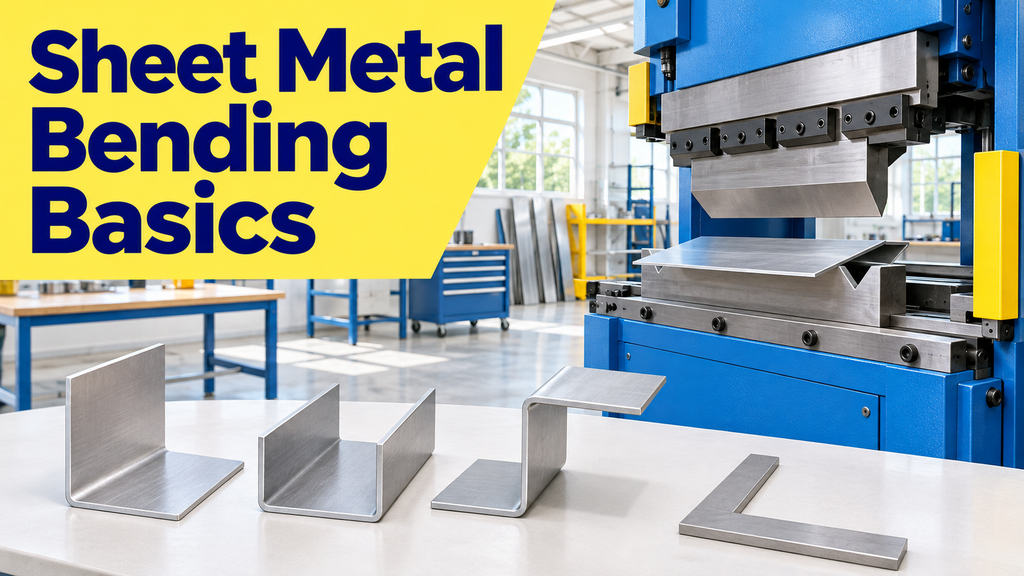
Sheet metal bending turns flat metal into brackets, enclosures, panels and countless everyday products. Understanding the basics helps designers create parts that are easier and cheaper to make, and helps fabricators produce accurate bends the first time.
Bending looks simple, but getting the right angle and dimensions depends on the material, thickness, tooling and method used. Metal stretches on the outside of a bend, compresses on the inside and springs back slightly when released. This guide explains key bending terms, common bending methods and machines, how to calculate bend allowance, how different materials behave and practical design and safety tips for clean, consistent results.
Table of Contents
Key Bending Terms
Learning the vocabulary makes drawings, quotes and shop conversations much easier.
- Bend line: the line on the flat sheet where the bend will be formed.
- Flange: the section of metal bent up from the main surface.
- Inside bend radius: the radius on the inner curve of the bend.
- Neutral axis: the layer inside the metal that neither stretches nor compresses during bending.
- K-factor: the position of the neutral axis as a ratio of thickness, commonly between about 0.3 and 0.5.
- Bend allowance: the length of the neutral axis through the bend, used to calculate flat blank size.
- Bend deduction: the amount subtracted from the outside flange lengths to find the flat length.
- Springback: the tendency of metal to partly return toward its original shape after bending.
Common Bending Methods
| Method | How It Works | Key Benefit |
|---|---|---|
| Air bending | Punch presses sheet partway into a V-die | Flexible, low tonnage |
| Bottoming | Sheet pressed against die walls | Better angle consistency |
| Coining | Very high force stamps the bend | Almost no springback |
| Wipe bending | Pad holds sheet while a die wipes the flange | Fast for high volumes |
| Roll bending | Rollers form gradual curves | Cylinders and large radii |
Air Bending
Air bending is the most common method on modern press brakes. The punch pushes the sheet into a V-shaped die without forcing it to the bottom, and the bend angle depends on how deep the punch travels. One set of tools can produce many different angles, and less force is needed. The trade-off is that springback must be compensated, usually by bending slightly past the target angle.
Bottoming and Coining
In bottoming, the punch presses the sheet firmly against the die walls, giving more consistent angles but requiring dedicated tooling for each angle and more force. Coining goes further, using several times more tonnage to thin the metal slightly at the bend and virtually eliminate springback. Coining is less common today because it wears tooling and needs very powerful machines.
Folding and Panel Bending
Folding machines clamp the sheet and swing a beam up or down to form the flange, which is gentle on surface finishes and ideal for large panels. Automated panel benders can form complex boxes and panels with many bends quickly and are popular in high-mix production of cabinets and enclosures.
Bending Machines and Tools
Press Brakes
The press brake is the core machine in most fabrication shops. Hydraulic press brakes offer high tonnage and are widely used for thick plate. Electric servo press brakes are faster, quieter and more energy efficient for thinner sheet. CNC controls and multi-axis backgauges position the sheet automatically and calculate bend sequences, improving accuracy and repeatability. Leading manufacturers include Trumpf, Amada, Bystronic and LVD.
Manual Brakes and Hand Tools
Box and pan brakes, also called finger brakes, allow small shops and hobbyists to form boxes and trays from thin sheet. Hand seamers and bench vices with angle bars handle small flanges and quick repairs.
Choosing the Right V-Die
For air bending, a common rule of thumb is to choose a V-die opening of about six to eight times the material thickness for mild steel, increasing for thicker plate and harder materials. A wider opening reduces the force needed but produces a larger inside radius, while a narrower opening creates a tighter radius but needs much more tonnage. Press brake tonnage charts show the force required per foot or metre of bend length for each material, thickness and die opening.
How to Calculate Bend Allowance
To make a part with accurate flange lengths, you need to know the size of the flat blank. Because metal stretches during bending, the flat length is not simply the sum of the outside dimensions.
The standard bend allowance formula is: bend allowance equals the bend angle in radians multiplied by the sum of the inside radius and the K-factor times the thickness. For a 90-degree bend, the angle in radians is about 1.571.
For example, a part 2 mm thick with an inside radius of 2 mm and a K-factor of 0.33 gives a bend allowance of 1.571 multiplied by 2.66, or about 4.18 mm. The flat length equals the two straight flange lengths, measured to where the bend begins, plus this bend allowance.
In practice, most shops use CAD software with sheet metal tools or bend deduction tables developed from test bends on their own machines and tooling. Making a test bend and measuring the result is the most reliable way to confirm values for a new material or tool set.
How Different Materials Behave
- Mild steel: bends easily and predictably, with moderate springback.
- Stainless steel: stronger and springs back more, needing more tonnage and greater overbending.
- Aluminium 5052: bends well and is a popular choice for formed aluminium parts.
- Aluminium 6061-T6: prone to cracking on tight bends, so larger radii or softer tempers are often needed.
- Copper and brass: soft and easy to form, but surfaces mark easily.
- High-strength steels: need larger radii, more force and careful springback control.
Grain Direction
Rolled sheet has a grain direction from the mill. Bending across the grain is less likely to crack than bending parallel to it, especially with harder alloys and tight radii. Where possible, orient parts on the sheet so critical bends run across the grain.
Design Tips for Bendable Parts
Good design makes parts cheaper, faster and more accurate to produce.
- Use a consistent bend radius: using the same inside radius throughout reduces tool changes.
- Respect minimum radius: a common starting point is an inside radius at least equal to the material thickness.
- Keep flanges long enough: flanges should usually be at least about four times the thickness so the sheet spans the die.
- Keep holes away from bends: place holes at least about two and a half times the thickness plus the bend radius from the bend line to avoid distortion.
- Add bend reliefs: small notches where a bend meets an edge prevent tearing.
- Bend in the same direction: fewer part flips speed up production.
- Allow tolerances: angle tolerances of around plus or minus one degree are typical for standard work.
Common Bending Problems and Fixes
- Angle too open: increase punch depth to compensate for springback.
- Cracking on the outside: increase the bend radius, bend across the grain or use a softer temper.
- Inconsistent angles: check for material thickness variation, worn tooling and machine crowning.
- Marks on the surface: use protective film, urethane die inserts or folding instead of press braking.
- Wrong flange length: recheck bend allowance values and backgauge positioning.
Press Brake Safety
Press brakes are powerful machines with dangerous pinch points between the punch and die. Most serious injuries involve hands caught in the point of operation.
- Use guarding such as light curtains, laser safety systems or two-hand controls.
- Never place hands between the punch and die.
- Support large sheets, which can whip upward during bending.
- Wear cut-resistant gloves when handling sheets with sharp edges, and safety glasses and steel-toe boots.
- Lock out the machine before changing tooling.
- Train operators on safe operation and follow machine safeguarding standards such as ANSI B11.3 and OSHA requirements.
Strong safety programmes reduce injuries, downtime and workers’ compensation claims, and help businesses meet insurance and inspection requirements.
Costs and Outsourcing
Buying a CNC press brake is a major investment, with prices ranging widely based on tonnage, length, control and automation. Many businesses outsource bending to fabrication shops, especially for low volumes. To get accurate quotes, provide 3D models and flat patterns, specify material and thickness, mark critical dimensions and tolerances, and ask the shop for its standard bend radii so your design matches their tooling. Larger shops often finance equipment through leasing or business loans.
Careers in Sheet Metal Fabrication
Skilled press brake operators, sheet metal workers and fabrication engineers are in steady demand across construction, HVAC, automotive, aerospace and electronics. Apprenticeships, technical college programmes and on-the-job training can lead to well-paid roles, especially for those who can program CNC press brakes and read complex drawings.
Final Thoughts
Sheet metal bending combines simple principles with careful control of material, tooling and technique. Learn the key terms, choose the right method and V-die, calculate bend allowance accurately, account for springback and design parts with consistent radii, adequate flanges and proper hole spacing. Combined with strong safety practices, these basics lead to accurate, cost-effective parts.
FAQs
1. What is the most common sheet metal bending method?
Air bending on a press brake is the most common, because it is flexible and requires less force.
2. What is springback in sheet metal bending?
Springback is the metal partly returning toward its original shape after bending, so fabricators overbend slightly.
3. What is a K-factor?
The K-factor shows where the neutral axis lies within the thickness and is used to calculate bend allowance.