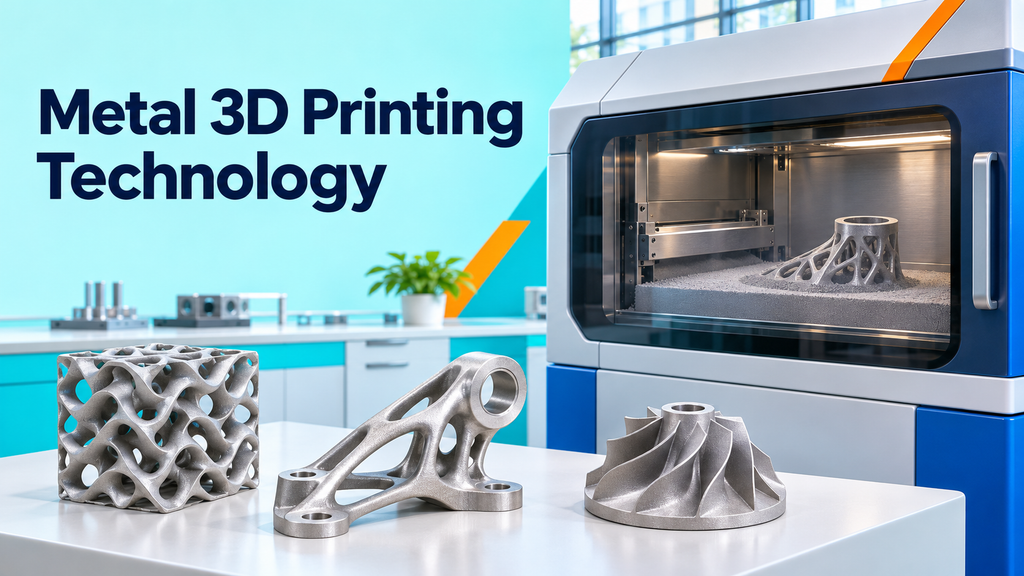
Metal 3D printing builds solid metal parts layer by layer directly from digital designs. It has moved from prototyping labs into full-scale production for jet engines, rockets, medical implants and industrial tooling.
Also known as metal additive manufacturing, the technology makes shapes that are impossible or very costly to produce with casting, forging or machining. Internal cooling channels, lightweight lattice structures and parts that once required dozens of welded components can now be printed as a single piece. This guide explains how metal 3D printing works, the main process types, the materials used, typical costs, real-world applications and what businesses should consider before investing.
Table of Contents
How Metal 3D Printing Works
Every metal printing process starts with a 3D computer model, usually created in CAD software. The model is sliced into thin layers, often a few tens of microns thick for precision processes. The printer then builds the part one layer at a time, fusing or binding metal powder or wire according to the shape of each slice.
After printing, almost all metal parts need further processing. This can include removing supports, heat treatment to relieve stress, densifying the metal, machining critical surfaces and finishing. Understanding this full workflow is essential, because post-processing often accounts for a large share of the total cost and time.
Main Types of Metal 3D Printing
| Technology | How It Works | Best For |
|---|---|---|
| Laser powder bed fusion | Laser melts powder layer by layer | Complex, precise parts |
| Electron beam melting | Electron beam melts powder in vacuum | Titanium implants and aerospace |
| Binder jetting | Binder glues powder, then sintered | Higher-volume small parts |
| Directed energy deposition | Melts wire or powder as it is fed | Large parts and repairs |
| Bound metal extrusion | Metal-filled filament, then sintered | Office prototypes and tooling |
Laser Powder Bed Fusion
Laser powder bed fusion, often called DMLS or SLM, is the most widely used metal printing process for production parts. A recoater spreads a thin layer of fine metal powder across a build plate, and one or more lasers melt the powder where the part should be. The plate lowers, a new layer is spread and the process repeats. The build takes place in an inert gas atmosphere, usually argon or nitrogen, to prevent oxidation.
The process produces dense, high-strength parts with fine detail and excellent mechanical properties. Its limits include build volume, the need for support structures on overhangs and relatively slow build speeds. Multi-laser machines with four, eight or even more lasers are increasing productivity for production work.
Electron Beam Melting
Electron beam melting uses a high-energy electron beam in a vacuum instead of a laser. The powder bed is kept hot during the build, which reduces residual stress. It is well suited to titanium alloys and is widely used for orthopaedic implants such as hip cups with porous surfaces that encourage bone growth.
Binder Jetting
Binder jetting deposits a liquid binding agent onto layers of metal powder, creating a fragile green part. The part is then cured and sintered in a furnace, where it shrinks and densifies. Because no melting happens during printing, binder jetting is much faster and better suited to producing large batches of small parts. Managing shrinkage during sintering is the main technical challenge.
Directed Energy Deposition
Directed energy deposition feeds metal wire or powder into a melt pool created by a laser, electron beam or electric arc. Wire arc additive manufacturing uses welding technology mounted on robots to build very large parts quickly. DED is also used to repair high-value components such as turbine blades, moulds and shafts by adding metal back to worn areas.
Bound Metal Extrusion
This approach uses filament or rods of metal powder held in a polymer binder, printed on machines similar to plastic 3D printers. Parts are then debound and sintered. It offers a lower-cost entry point for prototypes, jigs, fixtures and tooling, though parts generally have lower density and tighter size limits than laser-fused parts.
Materials Used in Metal 3D Printing
A wide range of alloys is available, each suited to specific applications:
- Titanium alloys: Ti-6Al-4V is strong, light and biocompatible, used in aerospace and medical implants.
- Nickel superalloys: Inconel 718 and 625 withstand extreme heat in jet engines, rockets and turbines.
- Stainless steels: 316L and 17-4 PH offer corrosion resistance for industrial and medical parts.
- Aluminium alloys: AlSi10Mg and newer high-strength grades provide lightweight parts for automotive and aerospace.
- Cobalt-chrome: used for dental frameworks and implants thanks to wear resistance and biocompatibility.
- Tool steels: maraging and H13 steels for moulds and dies.
- Copper alloys: excellent thermal and electrical conductivity for heat exchangers, induction coils and rocket combustion chambers.
Metal powders must meet strict requirements for particle size, shape and purity. Quality-controlled powder is expensive, and unused powder is usually sieved and reused under controlled procedures.
Advantages of Metal 3D Printing
- Design freedom: complex internal channels, lattices and organic shapes become possible.
- Part consolidation: assemblies of many parts can be printed as one, reducing joints, leaks and labour.
- Weight reduction: topology optimisation removes material where it is not needed.
- Faster development: prototypes and design changes need no new tooling.
- Customisation: patient-specific implants and low-volume custom parts are economical.
- Supply chain flexibility: spare parts can be printed on demand instead of stored in warehouses.
A well-known example is the fuel nozzle developed for the CFM LEAP jet engine, which combined around 20 separate parts into a single printed component that is lighter and more durable than the original design.
Limitations and Challenges
- High costs for machines, powders and skilled operators.
- Slower build rates than casting or machining for simple shapes.
- Post-processing requirements, including support removal, heat treatment and machining.
- Rough surface finish compared with machined parts.
- Residual stress, porosity and distortion if parameters are not controlled.
- Lengthy qualification and certification for regulated industries.
Post-Processing Steps
Most laser-fused parts follow a similar finishing route. Parts are first stress-relieved while still attached to the build plate, then cut off using a band saw or wire EDM. Supports are removed, and many critical parts undergo hot isostatic pressing, which applies high temperature and pressure to close internal pores and improve fatigue life. Finally, surfaces are machined, blasted, polished or coated, and parts are inspected using CT scanning, dimensional measurement and mechanical testing.
Industries Using Metal 3D Printing
Aerospace and Space
Aerospace is the largest user of metal additive manufacturing. Engine components, brackets, heat exchangers and rocket engine parts benefit from weight savings and part consolidation. Space companies print combustion chambers and injectors with internal cooling channels that would be very difficult to make any other way.
Medical and Dental
Orthopaedic implants with porous surfaces, custom cranial plates, spinal cages and dental crowns and bridges are produced in large numbers. Printing allows implants tailored to a patient’s anatomy using CT scan data.
Automotive and Motorsport
Racing teams use metal printing for lightweight brackets, exhaust parts and cooling components. Carmakers use it for prototypes, tooling and limited-run parts.
Energy and Industrial
Gas turbines, oil and gas equipment and heat exchangers benefit from complex cooling and repairs. Mould makers use conformal cooling channels in injection mould inserts to cut cycle times.
Cost of Metal 3D Printing
Industrial laser powder bed fusion systems typically cost from a few hundred thousand dollars to well over a million dollars for large multi-laser machines, before adding powder handling, furnaces, inert gas supply and finishing equipment. Office-friendly bound metal systems cost less but still represent a significant investment.
For many companies, using a service bureau is the most practical way to start. Part prices depend on build height, material, volume, support needs and finishing. Comparing quotes from several providers and designing specifically for additive manufacturing can greatly reduce cost per part. Larger investments are often funded through equipment financing or leasing.
Leading Companies and Systems
Major manufacturers of metal printing systems include EOS, Nikon SLM Solutions, Colibrium Additive (formerly GE Additive), 3D Systems, Renishaw, Trumpf, Velo3D and HP for metal binder jetting. Each offers different build sizes, laser counts, materials and software ecosystems, so businesses should match the platform to their parts and production volumes.
Designing for Metal Additive Manufacturing
Simply printing a part designed for machining rarely delivers the full benefit. Designers use topology optimisation and generative design software to place material only where loads require it. They orient parts to minimise supports, design self-supporting angles, typically around 45 degrees or steeper, and include features such as lattices and internal channels that add value. Training engineers in design for additive manufacturing is often the biggest factor in a successful programme.
Careers in Metal 3D Printing
Growing adoption has created demand for additive manufacturing engineers, machine operators, materials scientists, quality inspectors and design specialists. Engineering degrees, technical college programmes and industry certifications can open doors to well-paid roles in aerospace, medical device and defence manufacturing.
Final Thoughts
Metal 3D printing has become a proven production technology for complex, high-value parts. Powder bed fusion leads in precision, binder jetting in volume and directed energy deposition in size and repair. Success depends on choosing the right process and material, designing parts for additive manufacturing and planning for post-processing and quality control from the start.
FAQs
1. What is the most common metal 3D printing process?
Laser powder bed fusion is the most widely used process for high-quality, complex metal production parts.
2. Are 3D printed metal parts as strong as machined parts?
With proper parameters and heat treatment, printed parts can match or exceed the strength of cast and many wrought parts.
3. How much does a metal 3D printer cost?
Industrial systems usually cost from a few hundred thousand dollars to over a million, plus post-processing equipment.