Not every fire extinguisher works on every fire. Using the wrong type can make a fire spread, cause electric shock or create a dangerous flare-up.
Fire extinguishers are designed around the type of fuel that is burning, from wood and paper to petrol, live electrical equipment, cooking oil and combustible metals. Understanding fire classes and the extinguisher types that match them helps homeowners, landlords and businesses choose the right protection and use it with confidence. This guide explains each fire class, the main types of extinguishers, what their labels mean, where to place them and how to keep them ready for an emergency.
Table of Contents
Understanding Fire Classes
Fires are grouped into classes based on what is burning. In the United States, the five classes are:
- Class A: ordinary combustibles such as wood, paper, cloth, rubber and many plastics.
- Class B: flammable liquids and gases such as petrol, oil-based paint, solvents, propane and grease outside the kitchen.
- Class C: fires involving energised electrical equipment, such as wiring, appliances, panels and computers.
- Class D: combustible metals such as magnesium, titanium, sodium and lithium metal.
- Class K: cooking oils and fats in commercial kitchen equipment such as deep fryers.
Other regions use slightly different systems. In the UK, Europe and Australia, Class C covers flammable gases, Class F covers cooking oils and fats, and electrical fires are treated as a separate category rather than a lettered class. Always read the pictograms and labels on the extinguisher itself.
Main Types of Fire Extinguishers
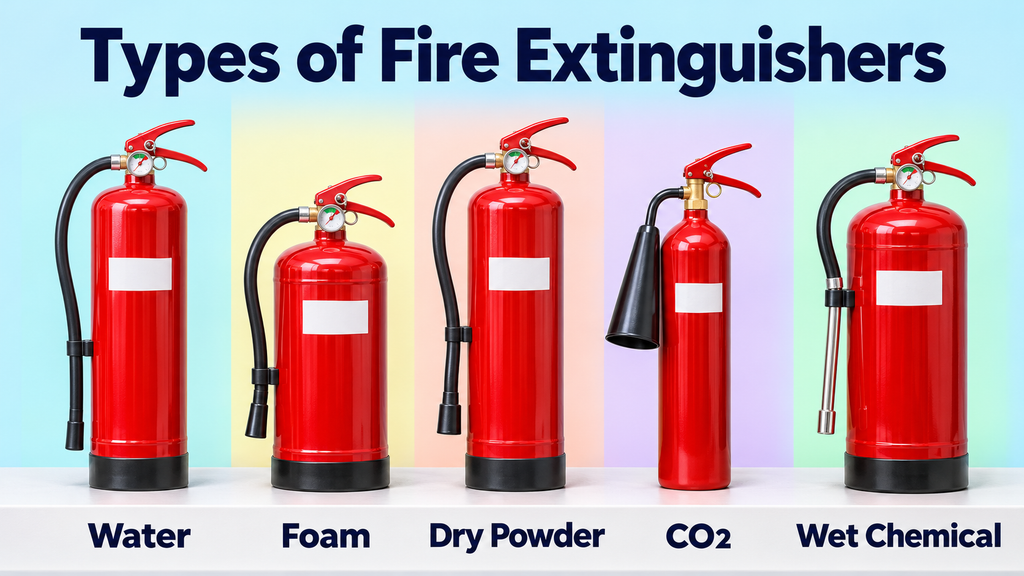
| Extinguisher Type | Fire Classes (US) | Common Locations |
|---|---|---|
| Water | A | Offices, schools, warehouses |
| Foam | A and B | Garages, fuel areas |
| Dry chemical (ABC) | A, B and C | Homes, vehicles, workshops |
| Carbon dioxide | B and C | Server rooms, labs |
| Wet chemical | K (and A) | Commercial kitchens |
| Clean agent | B and C (some A) | Electronics, museums, aircraft |
| Dry powder | D | Metalworking and labs |
Water Extinguishers
Water extinguishers cool burning material below its ignition temperature. They are effective and inexpensive for Class A fires involving wood, paper and fabric. They must never be used on electrical fires, because water conducts electricity, or on burning oil and fuel, where water can spread the fire. Water mist models break water into fine droplets and are safer near electrical equipment, though their suitability depends on the specific model’s rating.
Foam Extinguishers
Foam extinguishers smother flammable liquid fires by forming a blanket over the surface, cutting off oxygen and stopping vapours from escaping. They also cool Class A materials. Many older foam types contained PFAS chemicals, and fluorine-free foams are increasingly replacing them because of environmental and health concerns. Foam is not suitable for live electrical fires unless the model is specifically tested and rated for that use.
Dry Chemical Extinguishers
Dry chemical extinguishers are the most common type in homes and businesses. Multipurpose ABC extinguishers use monoammonium phosphate powder, which interrupts the chemical reaction of fire and coats Class A materials to prevent re-ignition. BC extinguishers use sodium bicarbonate or potassium bicarbonate and are common in fuel stations and some commercial kitchens’ back areas.
Dry chemical units are versatile and affordable, but the powder spreads widely, reduces visibility and can corrode electronics. Clean-up is messy, so they are less ideal for sensitive equipment.
Carbon Dioxide Extinguishers
CO2 extinguishers displace oxygen and cool the fire without leaving any residue, making them ideal for electrical equipment and flammable liquids. They are recognisable by their hard horn rather than a hose nozzle. The horn becomes extremely cold during discharge, so hold only the handle. CO2 has limited range and is less effective outdoors or in wind, and it should be used carefully in small enclosed spaces because it lowers oxygen levels.
Wet Chemical Extinguishers
Wet chemical extinguishers are designed for cooking oil and fat fires in deep fryers and commercial cooking equipment. They spray a fine mist of potassium-based solution that cools the oil and reacts with it to form a soapy layer, a process called saponification, which seals the surface and prevents re-ignition. Commercial kitchens are generally required to keep a Class K extinguisher near cooking appliances, alongside a fixed suppression system over the cooking line.
Clean Agent Extinguishers
Clean agent extinguishers use gases such as Halotron or other halocarbon replacements that leave no residue and do not conduct electricity. They protect expensive equipment in data centres, telecom rooms, aircraft, boats, laboratories and museums. They cost more than dry chemical models but avoid damage to electronics and valuable items. Older halon extinguishers are no longer produced because of their effect on the ozone layer.
Dry Powder Extinguishers
Class D extinguishers contain specialised powders, such as sodium chloride or copper-based agents, that smother burning metals and absorb heat. Different metals may need different agents, so the extinguisher must match the metals used on site. Using water or standard extinguishers on burning metal can cause violent reactions.
Lithium-Ion Battery Fires
Fires in e-bikes, scooters, power tools and electric vehicles involve thermal runaway, where damaged battery cells heat themselves and release flammable gases. Standard extinguishers can knock down flames, but batteries may reignite. Large amounts of water are often recommended to cool battery packs, and some newer extinguishers are marketed specifically for lithium-ion fires. For any battery fire, get everyone out, call emergency services and avoid breathing the smoke, which can be toxic.
How to Read Extinguisher Ratings
In the US, extinguisher labels show a rating such as 2-A:10-B:C. The number before A indicates water-equivalent capacity, with each unit equal to about 1.25 gallons of water. The number before B indicates roughly how many square feet of flammable liquid fire a non-expert can put out. The letter C means the agent is non-conductive and safe on live electrical equipment, and carries no number.
A higher rating means more fire-fighting power. For most homes, fire safety organisations suggest a multipurpose extinguisher rated at least 2-A:10-B:C on each level.
Choosing the Right Extinguisher
Start by listing the fire risks in each room or work area, then match an extinguisher to the most likely type of fire in that space.
- Homes: an ABC extinguisher on every floor, plus one near the kitchen and in the garage.
- Kitchens at home: an ABC or a model rated for kitchen use, kept away from the stove so you can reach it safely.
- Vehicles and boats: compact ABC or BC units mounted securely.
- Offices: water or ABC for general areas, CO2 or clean agent near electronics.
- Commercial kitchens: Class K wet chemical near cooking equipment.
- Workshops and garages: ABC or foam for flammable liquids, Class D where metals are machined.
Buy extinguishers listed by a recognised testing laboratory, such as UL, and choose a size you can handle comfortably. Reputable brands include Kidde, First Alert, Amerex and Badger.
How to Use a Fire Extinguisher: PASS
- Pull the pin, breaking the tamper seal.
- Aim the nozzle low, at the base of the fire.
- Squeeze the handle steadily to release the agent.
- Sweep from side to side until the fire is out.
Only fight a fire if it is small, contained, you have a clear exit behind you and the room is not filling with smoke. Call emergency services first or have someone else call. Most portable extinguishers empty in about 10 to 20 seconds, so if the fire is not going out quickly, leave immediately.
Placement and Maintenance
Mount extinguishers in visible, easy-to-reach locations near exits and escape routes, not hidden in cupboards. In workplaces, standards set maximum travel distances to the nearest extinguisher, commonly 75 feet for Class A hazards and shorter distances for flammable liquid and kitchen hazards.
- Check the pressure gauge monthly to make sure the needle is in the green zone.
- Look for dents, rust, damaged hoses and missing pins or seals.
- Have business extinguishers serviced annually by a certified technician under NFPA 10 standards.
- Follow hydrostatic testing schedules, commonly every five years for water, CO2 and wet chemical units and every twelve years for dry chemical units.
- Replace or recharge any extinguisher after use, even if only partly discharged.
Employers in the US must also provide extinguisher training under OSHA rules when employees are expected to use them. Keeping fire safety equipment up to date can also help when dealing with commercial property insurance and fire inspections, and some home insurers recognise safety devices when reviewing policies.
Final Thoughts
The right fire extinguisher depends on what might burn: water and foam for ordinary materials and liquids, ABC dry chemical for general use, CO2 and clean agent for electronics, wet chemical for commercial cooking oil and dry powder for metals. Choose rated, listed extinguishers, place them where they are easy to reach, inspect them monthly and learn the PASS method so you can act quickly and safely.
FAQs
1. What is the best fire extinguisher for a home?
A multipurpose ABC dry chemical extinguisher rated at least 2-A:10-B:C suits most homes, with one on each floor.
2. Can I use water on an electrical fire?
No. Water conducts electricity and can cause shock. Use a CO2, clean agent or ABC extinguisher instead.
3. How often should fire extinguishers be checked?
Check them monthly yourself, and have business extinguishers professionally serviced once a year.