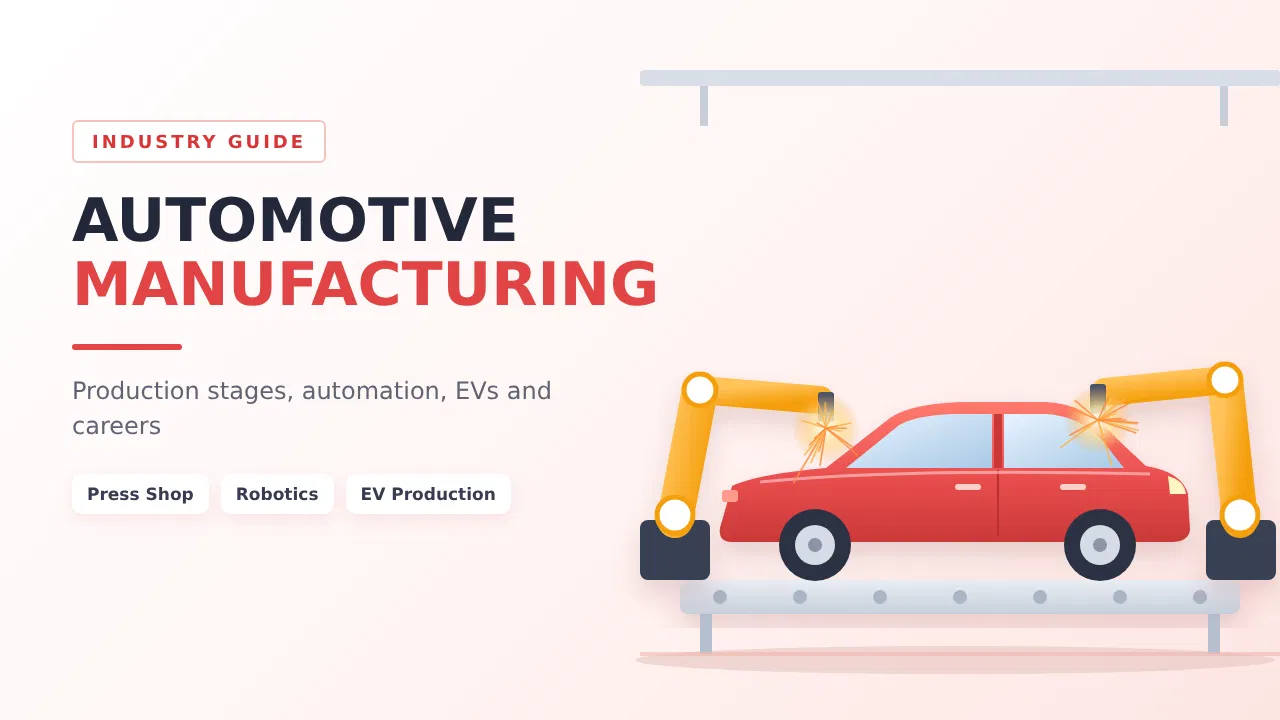
Industrial robotics has become one of the most powerful forces in modern manufacturing. Robots now weld car bodies, assemble electronics, pack food, palletise boxes and handle heavy parts in factories across the world, working with speed and precision that human hands alone cannot match.
What was once affordable only for large automakers is now within reach of small and medium businesses. Falling robot prices, easier programming and the rise of collaborative robots have made automation a practical choice for companies of all sizes. This guide explains the main types of industrial robots, how they work, where they are used, what they cost and how businesses can calculate the return on their investment.
Table of Contents
What Is an Industrial Robot
An industrial robot is a programmable, automatically controlled machine that can move in several directions, known as axes, to perform manufacturing tasks. According to international standards, it must be reprogrammable and capable of handling different jobs without changing its basic structure.
Unlike fixed automation, which is built for one specific task, a robot can be reprogrammed for new products or processes. This flexibility is the main reason robots have become central to modern production lines.
Main Types of Industrial Robots
Robots come in different designs, each suited to particular tasks, payloads and workspaces.
Articulated Robots
Articulated robots have rotary joints that work like a human arm, usually with six axes. They can reach almost any point within their work envelope and handle tasks such as welding, painting, machine tending and material handling. They are the most common type in automotive and heavy industries.
SCARA Robots
SCARA robots move quickly in a horizontal plane with limited vertical movement. They are ideal for fast pick-and-place, small part assembly, screw driving and electronics production where speed and repeatability matter most.
Delta Robots
Delta or parallel robots have three or four lightweight arms connected to a single base above the work area. They are extremely fast and are widely used for sorting and packing food, pharmaceuticals and small consumer products on conveyor lines.
Cartesian and Gantry Robots
Cartesian robots move along straight X, Y and Z axes. Gantry versions span large areas and are used for loading CNC machines, palletising, 3D printing and handling large panels. Their simple design makes them easy to program and very accurate.
Collaborative Robots
Collaborative robots, or cobots, are designed to work safely alongside people without heavy fencing. Built-in force sensors stop the robot on contact. Cobots are easy to teach by hand-guiding and are popular with small manufacturers for screw driving, packaging, quality checks and machine tending.
Autonomous Mobile Robots
Autonomous mobile robots navigate factories and warehouses using sensors and maps to move materials between stations. Unlike older guided vehicles, they do not need fixed tracks and can find their own routes around obstacles.
| Robot Type | Main Strength | Common Task |
|---|---|---|
| Articulated | Flexible reach | Welding, Painting |
| SCARA | High speed, precise | Small Assembly |
| Delta | Very fast picking | Food Packing |
| Cartesian | Accurate, simple | Machine Loading |
| Cobot | Safe near people | Light Assembly |
| Mobile Robot | Free navigation | Material Transport |
Key Components of a Robot System
A working robot cell is more than just the robot arm. It includes several components that must work together smoothly.
- Manipulator: the mechanical arm with joints, motors and gearboxes
- Controller: the computer that stores programs and controls motion
- Teach pendant: a handheld device used to program and operate the robot
- End effector: the tool at the end of the arm, such as a gripper, welding torch or spray gun
- Sensors and vision: cameras, force sensors and proximity sensors for guidance and safety
- Safety system: fences, light curtains, area scanners and emergency stops
How Robots Are Programmed
Robots can be programmed in several ways, depending on the task and the skills available.
Teach pendant programming involves moving the robot step by step to record positions. Offline programming uses simulation software to create and test programs on a computer before loading them to the robot, reducing downtime. Hand-guiding, common with cobots, lets operators physically move the arm to teach paths. Newer systems also use vision and artificial intelligence to recognise parts and plan movements automatically.
Applications Across Industries
Industrial robots are used wherever tasks are repetitive, dangerous, heavy or need high precision.
- Automotive: spot welding, painting, sealing and final assembly
- Electronics: placing components, soldering and testing circuit boards
- Metal fabrication: arc welding, cutting, bending and grinding
- Food and beverage: picking, packing, palletising and hygienic handling
- Pharmaceuticals: sterile filling, inspection and laboratory automation
- Logistics and e-commerce: sorting parcels and moving goods in warehouses
- Plastics: unloading moulding machines and trimming parts
Cost of Industrial Robots and Return on Investment
The price of an industrial robot depends on its type, payload, reach and brand. However, the robot arm is often only a portion of the total project cost. Grippers, safety equipment, conveyors, fixtures, programming and installation can add significantly to the final budget.
To judge whether a robot is worth it, companies calculate return on investment by comparing total cost with savings from reduced labour, higher output, fewer defects, lower scrap and reduced injury risk. Many well-planned robot projects pay back their investment within two to three years, especially when running multiple shifts.
Financing Options
Businesses can fund robots through machinery loans and equipment finance from banks such as SBI, HDFC Bank and ICICI Bank, or through NBFCs. Leasing and robot-as-a-service models let companies pay monthly instead of making a large upfront payment. Small manufacturers can also explore MSME credit schemes and technology upgrade support. Machinery breakdown insurance is recommended to protect this costly equipment against sudden failures.
Leading Robot Manufacturers
The global market is led by FANUC, ABB, Yaskawa, KUKA, Kawasaki, Nachi, Epson, Denso and Universal Robots, which pioneered collaborative robots. Many system integrators in India and abroad design complete robotic cells using these brands, providing installation, programming and service support.
Safety Standards and Best Practices
Robots move with great speed and force, so safety is essential. International standards such as ISO 10218 and ISO/TS 15066 for collaborative applications define how robots and cells must be designed and guarded. A proper risk assessment should be carried out before any robot goes into production.
Good practices include physical guarding or safety scanners, clear marking of robot zones, regular training for operators and maintenance teams, and lock-out procedures during servicing. Employers should also maintain workmen’s compensation and group health insurance for workers on automated lines.
Careers in Industrial Robotics
The spread of automation is creating strong demand for skilled professionals. Popular roles include robot programmer, robotics engineer, automation technician, maintenance engineer, vision systems engineer and robotic system integrator. Courses in mechatronics, electrical, electronics and mechanical engineering, along with certifications from robot makers, open doors to well-paid jobs in India and abroad.
The Future of Industrial Robotics
Robots are becoming smarter, safer and easier to use. Artificial intelligence allows them to pick random parts from bins, adapt to changes and learn from experience. Humanoid and mobile manipulators are being tested for flexible tasks in warehouses and factories. As costs fall further, robotics will spread into small workshops, farms, construction sites and healthcare, making automation a normal part of everyday industry.
Conclusion
Industrial robotics helps businesses produce more, with better quality and safer working conditions. From articulated arms and SCARA robots to cobots and mobile robots, there is a solution for almost every production need. By choosing the right robot, planning the full cell carefully, arranging suitable financing and investing in skills and safety, companies can enjoy fast returns and stay competitive in a highly automated world.